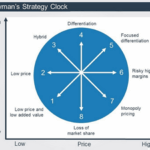
Bowman’s Strategy Clock presents various ways to position product/services and is a useful tool to understand how firms compete based on price and perceived value. Bowman’s strategic clock is another strategic tool that provides businesses with several options to position their products/services in the market. It suggests eight different ways to position product/services (BOWMAN & […]
Business Management
SAF (SAF) Strategy Model
The Suitability, Acceptability and Feasibility (SAF) method helps in evaluating strategies; as per the framework, a strategy must meet three criteria for it to be successful – it must be suitable, acceptable and feasible (JOHNSON and SCHOLES, 1997). SAF Method Suitability: An assessment of the underlying rationale or logic of the potential strategy. Does the […]
Porter’s Generic Strategies
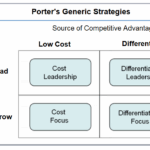
Porter’s generic strategies refers to strategies that companies can use to gain a competitive advantage in the market, such as Cost Leadership, Differentiation and Focus (Porter, 1985). Every business wants to assess and understand competition so that they can plan their actions accordingly, and stay ahead of it. They want to know who the competitors […]
Michael Porter: Top theories, models and frameworks
Michael Porter is one of the most influential strategic thinkers of the twentieth century. he is credited for coming up with several theories, models and frameworks that helps analyze businesses in strategic ways. “He has influenced more executives – and more nations – than any other business professor on earth.” – Geoff Colvin, Fortune magazine, […]
Zappos Case Study: Training and Development
Zappos cast study as mentioned in: Noe, R. A., Hollenbeck, J. R., Gerhart, B., & Wright, P. M. (2017). Human resource management: Gaining a competitive advantage. New York, NY: McGraw-Hill Education. Questions: What challenges is Zappos facing that may derail its attempt to be the best online retailer? How can training and development help Zappos […]
What is Strategy?
Strategy involves setting goals, determining the best course of actions and allocating resources to achieve those goals. Here’s an introduction to Strategy and Strategising. Strategy is a set of processes and activities which involves: assessing environmental changes to identify opportunities and threats, assessing internal strengths and weaknesses and ability to respond to environmental change, creation […]
Country Risk Analysis
Doing business or investing in foreign markets, especially emerging countries, carry a certain element of risk. The risks could be from the government that may decide to make changes to the country’s foreign investment rules, or it could be a small buyer deciding to cancel a contract due to some economic concerns. Country risk refers […]
Types of organizations
Organizations consist of several factors such as functions, people, resources, etc. Differing organisational goals and objectives implies a varying degree of importance on each of these factors, that eventually give rise to different types and structures of organizations. Daft, Murphy and Willmott (2010) identify and discuss the differences between small and large organizations and for-profit […]
Theory of the Firm
The theory of the firm, a microeconomic concept (in neoclassical economics), states that a company’s main goal should be to maximize profits, to create as big a gap between revenue and costs as possible by allocating resources to maximize net profits. The theory of the firm influences decision-making in several business areas, including resource allocation, […]
PESTLE / PESTEL Analysis: Tool to assess the Macro-Environment
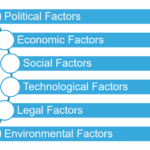
PESTLE analysis consists of components that influence the business environment and each letter in the acronym denotes a set of factors that directly or indirectly affect every industry. The Pestle analysis allows marketers to analyse the major environmental factors and examine the effect of these factors on marketing planning and implementation. What is PESTLE / […]
3 Levels of Strategy
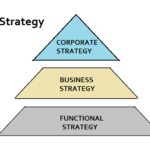
A strategy refers to the set of actions that managers in a company take to increase their company’s performance. The strategy formulation task is the task of selecting strategies, whereas strategy implementation is the task of putting strategies into action. Strategies can be divided into various categories such as Corporate-level strategies, Global strategies, business-level strategies […]
Resource Based View (RBV)
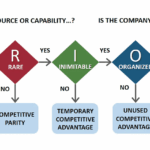
The resource-based view (RBV) of strategy asserts that the competitive advantage & superior performance of an organisation are explained by the distinctiveness of its capabilities. It is sometimes also called the ‘capabilities view’. Proponents of RBV (such as Birger Wernerfel, Prahalad and Hamel, Barney) suggested that a firm should look within the firm to find […]
Ethical Theories: Overview
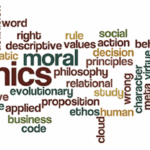
Understand the meaning of various ethical theories and key business ethics terminology. What is Ethics? Ethics refer to moral principles that govern a person’s behaviour or the conducting of an activity. It’s the branch of knowledge that deals with moral principles. More definitions: “Morality is concerned with the norms, values and beliefs embedded in social […]
Kant’s Ethical Theory: Kantian Ethics, Categorical Imperatives, Morality
German philosopher Immanuel Kant (1724–1804) is one of the most important philosophers although he is not very easy to understand. Kant was not a consequentialist, but attempted to base his moral theory on human reason rather than on feeling, as the utilitarians do. Kant starts off with the basic question, “What is a moral belief?” […]
TOWS Matrix
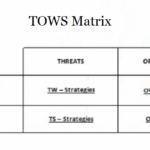
The TOWS Matrix is a framework that enables businesses to come up with business strategies based on its SWOT analysis, by connecting the internal as well as the external factors (Weihrich, 1982). Considering the strengths, weaknesses, opportunities (SWOT) and these in mind, further strategies are formulated. Advantages of Using the TOWS Matrix A TOWS MATRIX […]
What is Organisational Lifecycle?
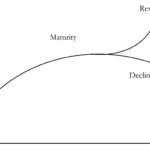
Every organization goes through different phases; an organizational life cycle divided into the following phases: Existence / Start-up (or Birth): Early days of the company. Survival: Organizations try to expand their business (try to achieve growth) Maturity phase: Company reaches the peak from where it becomes difficult to grow further. Renewal Phase: Companies may reinvent […]
Management Principles, Theories, Concepts

Management theories are concepts related to sound management strategies, including any tools and frameworks that can be implemented in modern organizations. Contribution of F.W. Taylor towards management. Frederick Taylor’s theory of scientific management developed techniques for improving the efficiency of the work process. Based on a systematic study of people, tasks and work behavior, Taylor’s […]
Latest Human Resource Management Project Topic Ideas
Latest Human Resource Management Project Topic Ideas for MBA and other students HR Project Topics Role of HR in boosting employee morale and motivating employees post Covid Employment trends (what is changing in the job market) post Covid Role of HR in the Gig economy as permanent jobs making way for short-term work or gigs […]
Mergers and Acquisitions (M&A)
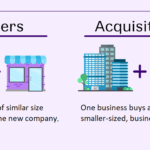
Mergers and Acquisitions An acquisition is when you buy another business and end up controlling it. A merger is when you integrate your business with another and share control of the combined businesses with the other owner(s). Mergers and Acquisitions are often treated together in the literature, legally they are transactions of a different kind. […]
Group Health Insurance: Strong employee retention tool
Health is Wealth is a very famous saying, and everyone tries different methods to maintain their wellbeing. However, life never follows a fixed pattern and thus, bodily injury or sudden illness can occur to anybody and may leave one both financially and physically stressed. Therefore, it is always good to have a medical insurance policy […]