
• Skip to primary navigation
  • Skip to main content
  • Skip to primary sidebar
  • Skip to footer
  • Call: (+91) 9892486442
  • email: info@academicshq.com

AcademicsHQ - Educational resource hub

Comprehensive guides for students and lifelong learners

Business Analysis

  • We help business analysts, students, and managers craft better analysis.
  • Contact us for more information
  • Home
  • Research Process
  • Academic Writing
  • Referencing Guide
  • Resume Writing
Home » Blog » Schiffman and Kanuk’s model of Consumer Behaviour

Schiffman and Kanuk’s model of Consumer Behaviour

February 18, 2022 by academicshq Leave a Comment

consumer buying behaviour

Schiffman and Kanuk uses a marketing segmentation approach to explain Consumer Behaviour. The authors have explained the model in their book named ‘Consumer Behaviour’.

Consumer buying behaviour is the study of the buying behaviour of consumers; it tries to understand the decision making process of the consumer, their shopping habits and purchasing behavior. Schiffman and Kanuk explain how the intenet has changed the way how consumers research for a product before making a decision.

Every customer goes through a buying decision making process that comprises of several steps such as becoming aware of a need, finding information to look for solutions to satisfy the need, eveluation of the various alternatives, making the purchase and a post-purchase decision.

Schiffman & Kanuk’s model of consumer decision making suggests that this process can be categorized under three stages. The model by Shiffman and Kanuk (2000) highlights the three stages and shows the many variables that can impact on the decision to purchase. It shows three distinct but intertwining stages: the input stage, the process stage, and the output stage.

Figure: Model of Consumer Decision-Making (Schiffman, Hansen and Kanuk, 2000)
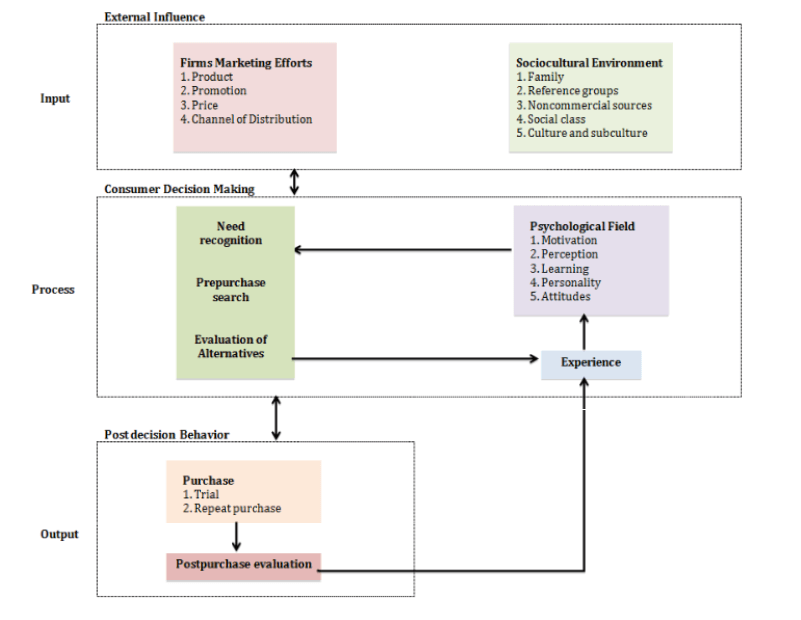
Schiffman and Kanuk model of Consumer Behaviour

Contents hide
1 Input Stage (External influences)
2 Process Stage (Consumer Decision Making)
3 Output Stage (Post-decision behaviour)
4 References
5 Related posts:

Input Stage (External influences)

Influences the consumers recognition of a product need, through 2 sources of information:

  1. the firms Marketing efforts (4 p’s) – Product, Promotion, Price, Channels of Distribution.
  2. the external socio-cultural influence –family, friends, social class, culture, informal sources, other non-commercial sources, etc.

Both the factors impact buying decision.

Process Stage (Consumer Decision Making)

This stage focuses on how consumers make decisions.

Need recognition, pre-purchase search and evaluation of alternatives influenced by psychological factors – motivation, learning, perception, personality and attitude.

Output Stage (Post-decision behaviour)

Relates to 2 activities:

  1. 1) Purchase behaviour – Trial, repeat purchase
  2. 2) Post purchase evaluation – satisfaction, dissatisfaction, return, after sales influence these decisions

References

Shiffman, L. and Kanuk, L., 2000. Consumer learning. Consumer behavior, 192.

SCHIFFMAN, LEON G., AND LESLIE LAZAR KANUK 1987 Consumer Behavior. Third edition. Prentice-Hall, Englewood Cliffs, New Jersey.

Related posts:

  1. AIDA model explained
  2. Pricing Concepts (Marketing Mix)
  3. Customer Value and Customer Perceived Value (CPV)
  4. Brand Extension Strategy Explained: Types and Examples
  5. Marketing Communications (MarCom) and Integrated marketing communication (IMC)

Filed Under: Marketing & Sales

Reader Interactions

Leave a Reply Cancel reply

Your email address will not be published. Required fields are marked *


Primary Sidebar

Microsoft Excel Tutorials
Want to master Excel? Check out our free tutorials on YouTube

Academic Writing: Best Practices

  • How to Choose a Research Topic
  • Academic Writing Guide: Tips & Checklist
  • How to evaluate information sources (CARS Checklist)
  • How to write Literature Review
  • Referencing (Citing) Guide: Harvard, APA and Other Styles
  • How to write conclusion for academic work

Recent Posts

  • Budgeting 101: How Firms Control Their Finances
  • A Tomato that pushes you hard
  • Types of Market Structures Explained
  • The Stability (and Instability) of the Market Economy
  • Measures of Economic Activity and Wellbeing

Footer

ACADEMIC

  • Academic Writing Guide
  • Statement of Purpose
  • Letter of Motivation
  • Personal Statement
  • Letter of Recommendation

JOB

  • Cover Letter
  • Letter of Intent
  • Resume
  • LinkedIn Profile Writing

BUSINESS

  • Pitch Deck
  • Article Writing
  • Blog Writing
  • Case Study
  • Press Release
  • Business Plan
  • Ghostwriting

ABOUT US

  • About Us
  • Contact
  • Privacy Policy
  • Blog

Copyright © 2026 · News Pro on Genesis Framework · WordPress · Log in