• Skip to primary navigation
  • Skip to main content
  • Skip to primary sidebar
  • Skip to footer
  • Call: (+91) 9892486442
  • email: info@academicshq.com

AcademicsHQ - Educational resource hub

Comprehensive guides for students and lifelong learners

Business Analysis

  • We help business analysts, students, and managers craft better analysis.
  • Contact us for more information
  • Home
  • Research Process
  • Academic Writing
  • Referencing Guide
  • Resume Writing
Home » Blog » Lawrence Kohlberg’s Moral Development Process

Lawrence Kohlberg’s Moral Development Process

November 12, 2025 by academicshq

Ethics is the study of what is morally right and wrong, or a set of beliefs about what is morally right and wrong. To arrive at that set of beliefs and put them into practice requires moral development.

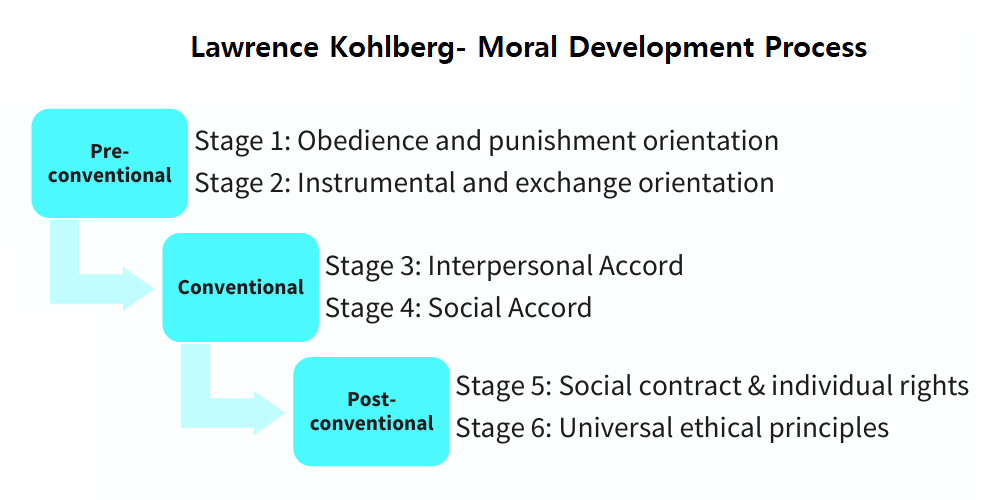
Lawrence Kohlberg’s Moral Development Process suggests that moral development occurs in six stages, grouped into three levels:

  • Preconventional
  • Conventional
  • Postconventional

Kohlberg proposed three levels of moral development in which progress happens sequentially from a lower stage to the higher stage.

Moral development happens through increasingly complex reasoning by exposure to moral dilemmas. Not everyone reaches the highest stage though.

Preconventional

Stage 1: Obedience and punishment orientation.

Motivation: Fear of punishment.
Example: One shouldn’t steal because one could go to jail.

Stage 2: Instrumental and exchange orientation.

Motivation: Self-interest. “What’s in it for me?”
Example: One may steal if he won’t get caught—it’s worth the risk.

Conventional

Focus is on Social norms, laws, and duty.

Stage 3: Interpersonal Accord (Good Interpersonal Relationships).

Motivation: Approval of others; relationships
Example: One should steal to save his wife, she’s family.

Stage 4: Social Accord (Maintaining Social Order).

Motivation: Social order; law and order
Example: Stealing is wrong even to save a life—laws must be upheld.

Post conventional

Focus is on Abstract ethical principles.

Stage 5: Social contract & individual rights.

Motivation: Social contract; human rights
Example: Laws protect property, but the right to life is more fundamental—stealing may be justified.

Stage 6: Universal ethical principles.

Motivation: Universal ethics (e.g., Kant, Rawls)
Example: Human life has inherent value; one must act according to the principle of preserving life, even if it means breaking a law.

Related posts:

  1. Business Ethics & Responsibility: Theories, Definition, Principles, Examples
  2. Stakeholder Theory Explained
  3. Who is a Stakeholder? Definition and Examples
  4. Kant’s Ethical Theory: Kantian Ethics, Categorical Imperatives, Morality
  5. Ethical Theories: Overview

Filed Under: CSR, Ethics & Sustainability:

Primary Sidebar

Microsoft Excel Tutorials
Want to master Excel? Check out our free tutorials on YouTube

Academic Writing: Best Practices

  • How to Choose a Research Topic
  • Academic Writing Guide: Tips & Checklist
  • How to evaluate information sources (CARS Checklist)
  • How to write Literature Review
  • Referencing (Citing) Guide: Harvard, APA and Other Styles
  • How to write conclusion for academic work

Recent Posts

  • Budgeting 101: How Firms Control Their Finances
  • A Tomato that pushes you hard
  • Types of Market Structures Explained
  • The Stability (and Instability) of the Market Economy
  • Measures of Economic Activity and Wellbeing

Footer

ACADEMIC

  • Academic Writing Guide
  • Statement of Purpose
  • Letter of Motivation
  • Personal Statement
  • Letter of Recommendation

JOB

  • Cover Letter
  • Letter of Intent
  • Resume
  • LinkedIn Profile Writing

BUSINESS

  • Pitch Deck
  • Article Writing
  • Blog Writing
  • Case Study
  • Press Release
  • Business Plan
  • Ghostwriting

ABOUT US

  • About Us
  • Contact
  • Privacy Policy
  • Blog

Copyright © 2026 · News Pro on Genesis Framework · WordPress · Log in