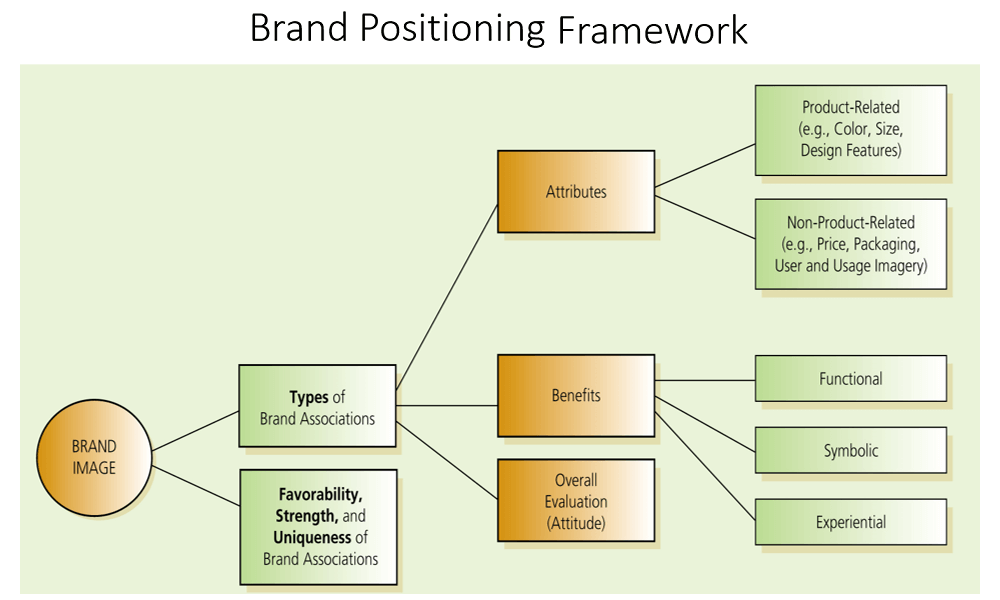
Brand positioning is about creating a suitable image for a brand in the minds of the target audience. As part of this process, the unique features of the brand are identified and is communicated effectively to create a distinct image of that brand to the target market.
While brand positioning and positioning are part of the STP (Segmentation, Targeting, and Positioning) model in marketing are related concepts, they are not exactly the same.
Positioning in the STP model involves creating a unique value proposition (for the products or services) and communicating that value proposition effectively to the target market.
Brand positioning, on the other hand, focuses specifically on creating a distinctive image for the brand itself rather than on the positioning of products or services in the market.
Brand Positioning: Factors to Consider
When positioning a brand, these things must be considered:
Attributes: What features benefits can be highlighted about this brand? Does it solve a problem? Does it satisfy a need? What are its functional or emotional attributes?
Attitudes: What should the consumers think or feel when they think about these features and this brand? More innovative? Better quality? More convenient? What attitude should they have towards it?
Positioning: What can be said to highlight the brand features and enhance the attitude? Because you are worth it? Just do it?
Developing Brand Concepts
Here’s how to develop Brand Concepts. This involves appealing to Consumer Needs by addressing their following needs:
Functional needs (solving problems): products that attempt to fulfill the consumer’s consumption-related problems (quality, convenience, ease of use). It communicates that the brand’s benefits are capable of solving consumers’ consumption-related problems.
Symbolic needs (associating the brand with symbolic objects): directed at consumers’ desire for self-enhancement, role position, group membership, and belongingness (friendly, serious, professional). It is about associating brand ownership with a desired group, role, or self-image.
Experiential needs (sensory pleasures, personal experience): products that provide sensory pleasure, variety, and/or cognitive stimulation (I am important, trendy, young). It promotes brand’s extraordinary sensory value, or rich potential for cognitive stimulation.
Adoption Process and Marcom Tools
The adoption process in brand positioning refers to the process by which a company positions its brand in the minds of their target audience to encourage adoption or acceptance of their brand.
Use of Marcom Tools in the Adoption Process:
- Awareness Class: Free samples and coupons, Trade shows and personal selling, Advertising, Social Media, Distribution
- Trier Class: Coupons, Widespread distribution, Introductory low pricing
- Repeater Class: Personal selling, Advertising, Social Media, Price, Distribution, Product satisfaction, Price
Hierarchy of Marcom Effects
The hierarchy of effects metaphor implies that for marketing communications to be successful it must move consumers from one goal to the next goal.
The hierarchy of effects related to advert.
Advancing Consumers from Unawareness to Awareness: Creating awareness is essential for new or unestablished brands.
Creating an Expectation: Instill in consumers an expectation of what product benefit(s) they will obtain from buying and experiencing a brand.
Encouraging Trial Purchases: The consumer tries the brand for the first time. This is the role of the sales promotion component of marcom.
Forming Beliefs and Attitudes: Upon trying a brand for the first time, the consumer will form beliefs about its performance. These beliefs, in turn, form the basis for developing an overall attitude toward the brand. Beliefs and attitudes are mutually reinforcing.
Consumer’s MAO to Process the Message
Enhancing Consumers’ Motivation, Opportunity, and Ability (MAO) to Process Brand Information.
Enhance Consumers’ MOTIVATION to Attend to the message by:
- Appealing to hedonic needs (appetite appeals, sex appeals)
- Using novel stimuli (unusual pictures, different ad formats, large number of scenes)
- Using intense or prominent cues (action, loud music, colorful ads, celeb-rities, large pictures)
- Using motion (complex pictures; edits and cuts)
Enhance Consumers’ MOTIVATION to Process brand information by:
- Increasing relevance of brand to self (asking rhetorical questions, using fear appeals, using dramatic presentations)
- Increasing curiosity about the brand (opening with suspense or surprise, using humor, presenting little information in the message)
Enhance Consumers’ OPPORTUNITY to Encode information by:
- Repeating brand information
- Repeating key scenes
- Repeating the ad on multiple occasions
Enhance Consumers’ OPPORTUNITY to Reduce processing time by:
- Creating Gestalt processing (using pictures and imagery)
Enhance Consumers’ ABILITY to Access knowledge structures by:
- Providing a context (employing verbal framing)
Enhance Consumers’ ABILITY to Create knowledge structures by:
- Facilitating exemplar-based learning (using concretizations, demonstrations, and analogies)
Specifying Media Objectives
Media Objectives are different from Campaign Objectives:
- Reach: What proportion of the population should be reached with advertising message during specified period?
- Frequency: How frequently should audience be exposed to message during this period?
- Weight: How much total advertising is needed to accomplish reach and frequency objectives?
- Continuity: How should the advertising budget be allocated over time?
- Recency: How close to the time of purchase should the target audience be exposed to the advertising message?
- Cost: What is the most economically justifiable way to accomplish objectives?
Continuity
Continuity involves the matter of how advertising should be allocated during the course of an advertising campaign.
- Continuous Schedule: Relatively equal amounts of ad dollars are invested throughout the campaign.
- Pulsing: Some advertising is used during every period of the campaign, but the amount of advertising varies form period to period.
- Flighting: The advertiser varies expenditures throughout the campaign and allocates zero expenditures in some months.
Related: Marcom, its objectives & tools used to achieve them

Leave a Reply