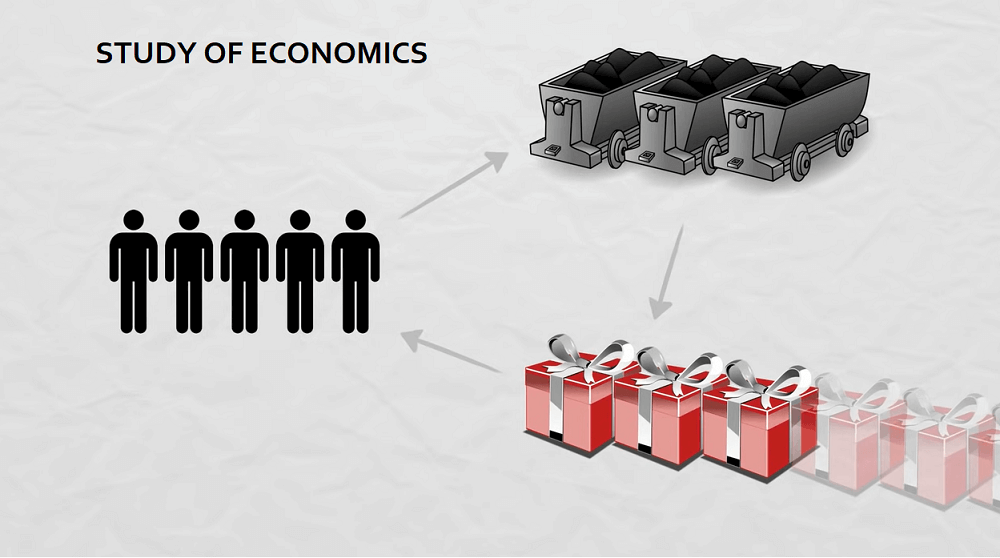
The learning outcomes for Economics are very broad and require us to take a critical perspective on economics. Thus, we cannot simply go through the typical introduction to economics topics such as the supply/demand model, perfect competition, monopoly, macroeconomic income determination and the like.
We do go through each of these topics but we also take a critical perspective of the dominant economic paradigm. We need to provide alternative perspectives on each of the concepts and theories we look at. Critically analysing something means that we need to stand outside the theory or concept and look upon it with a questioning eye.
Here we take a look at the concept of wellbeing.
While the concept of Gross Domestic Product (GDP) is a good measure of economic activity, it doesn’t measure well-being or even economic wellbeing. There are many things it leaves out of the equation and we introduce alternative measures such as the Human Development Index and Genuine Progress Indicator.
We refer to the collection of alternative theories as “political economy” but they are also often referred to as “progressive economics” or “heterodox economics” (in contrast to the dominant “orthodox economics” or “neoclassical economics”). Progressive economics or political economy encompasses many different perspectives such as institutional economics, ecological economics, feminist economics, Marxist economics, post Keynesian economics and the like.
Despite every textbook in economics pointing out that GDP is not a measure of wellbeing, orthodox economics and policy makers still seems to view GDP as a measure of wellbeing. Thus, policy and economic outcomes are seen as good if GDP increases and bad otherwise. But, of course, wellbeing depends on many things and sometimes growth is bad.
Neoclassical vs Political economy approaches to resolving issues
Society has to confront and resolve major economic issues such as:
- Economic growth vs less protection of the environment
- Economic imbalances such as budgetary, trade and the level of development among countries.
- The extent to which the redistribution of income (made more equal) is pursued via the taxation and transfer system.
The Neoclassical Approach
The neoclassical school of economic thought (also known as orthodox economics) emphasises the mechanism of the market (forces of demand and supply) in resolving major economic issues. The major economic issue of concern to this school is the need to efficiently allocate resources ( or factors of production) in order to maximise the production of goods and services (based upon the relative prices). Consequently, there is a limited role for government in the economy.
The major tenants of the neoclassical school are therefore:
- The dominance of the market
- Trade liberalisation
- Deregulation of markets to increase competition.
- Privatisation
- User pays principle for public services to rationalise demand and hence use resources more economically. This in turn leads to a more efficient use of resources by the public sector.
All of these tenants have a mutually reinforcing effect in promoting the efficient allocation resources that leads to the maximisation of production and hence wellbeing.
The political economy approach
The political economy school however criticises the neoclassical school on the basis that:
- The market is unlikely to efficiently allocate resources because of the limited competition (due to the dominance of imperfect competition such as oligopoly and monopoly) which weakens the forces of demand and supply and hence prevents equilibrium in the market.
- The market is only concerned with the efficient allocation of resources and hence higher production which in the process overlooks other issues such as the environment and a more equitable distribution of income.
This school therefore emphasises the need for direct government intervention in the economy in order to pursue objectives not related the efficient allocation of resources. They include:
- Protection of the environment
- Undertaking a more equal distribution of income.
Modern political economy (which derives from the political economy school) is based upon numerous schools of thought that include:
Classical political economy
The main elements of this school of thought are:
* Production is in surplus i.e. there is excess production relative to demand.
* Firms seek avenues to continuously increase production e.g. by specialising in production based upon the division of labour and engaging in international trade.
* How to distribute the output produced among capitalists, workers and landowners.
Marxist economics
This school of thought takes a more radical view of the economic system. The main tenants are:
* The drive by capitalists for capital accumulation (increase investment in equipment and factories) in order to maximise production (or surplus)
* Capital accumulation is motivated by the maximisation of profits which occurs at the expense of income (wages) to labour.
* The vying for profits by the owners of capital at the expense of labour leads to social discontent and hence a class struggle (revolution).
* The class struggle leads to political change in favour of labour.
Institutional economics
The main elements of this school of thought are:
*The market economy evolves over time e.g. the evolvement of firms from small to large multinational corporations. Furthermore, trade unions become larger seeking political influence.
* The market economy (forces of demand and supply) is inherently unstable which requires government intervention i.e. production and hence employment fluctuate that need to be stabilised via government policies.
Keynesian economics
This school of thought emphasises:
* The unstable nature of production and hence employment.
* The need therefore for government intervention to stabilise production and employment growth.
* Unemployment is prevalent (due to weak economic activity and real wages above equilibrium)
Neoclassical economics is useful and has a role to play in the economy. However, it is less effective in providing solutions to complex issues such as:
- Fluctuations in output and employment.
- Environmental degradation.
- The distribution of income.
Measuring wellbeing
GDP
Gross Domestic Product (GDP) is defined as the market value of final goods and services produced by the economy in a given time period. It is specifically used as:
- A measure of wellbeing
- An indicator of economic activity which impacts on employment growth.
Estimating GDP
GDP is estimated by three methods which are:
- The expenditure approach.
- Income approach.
- Value added approach.
The expenditure approach specifically states that:
GDP=C+I+G+NX
Where:
GDP= Gross Domestic Product
C= Private consumption expenditure by the household sector on goods and services.
I=Intended private investment expenditure on equipment (machinery) and structures (factories).
G=Government expenditure.
NX= exports (X) – imports (M) of goods and services.
Income Approach
The income approach is based upon the return to the factors of production which are assumed to be owned by the household sector. Thus, firms need to:
- Undertake expenditure on the use of land and buildings which leads to rental payments to the owners (the household sector).
- Undertake expenditure to hire labour which leads to the payment of wages to labour (the household sector).
- Borrow to undertake investment expenditure which leads to interest payments to the household sector which provides the funds (saving) via the banking sector.
- Leisure time
- Environmental degradation and resource depletion.
- Quality of life i.e. work/life balance
- Changes in the distribution of income.
- Finally, it is important to note that GDP does not include all goods and services produced by the market. This underestimates GDP as a measure of wellbeing.
- Consumption expenditure by the household sector on goods and services
- Changes in the distribution of income
- Household production of goods and services
- Education
- Use of highways and streets and other infrastructure.
- Social costs i.e. overcrowding in cities and traffic congestion.
- Environmental costs
- Life expectancy at birth
- The level of education
- GDP per capita
Specifically, estimating GDP via the income approach is illustrated below:
The return to land and buildings -rent
The returns to labour – wages
The return to capital – interest
+ Indirect taxes
– Subsidies
GDP at market prices
Value added approach
GDP can also be estimated by calculating the value added of each industry i.e.
Value added = revenue – input costs.
It is important to emphasise that all three measures of GDP will yield the same value for GDP.
Nominal vs real GDP
Nominal GDP=real GDP + inflation rate
Therefore, Real GDP= Nominal GDP – inflation rate
GDP and Economic Wellbeing
Increases in GDP over time do not necessarily translate into increases in wellbeing. This is due to numerous factors not incorporated into this measure. These include:
Alternative Measures of Wellbeing
Wellbeing therefore is not only the product of the production of goods and services in the economy but also non-economic factors. One measure which attempts to incorporate both economic and non-economic factors of wellbeing is the Genuine Progress Indicator (GPI). The important features of this indicator include the incorporation of the following:
A monetary value is ascertained of all the above factors of wellbeing.
Another measure of wellbeing is the Human Development Index (HDI) which is produced by the U.N. The important features of this method are that it incorporates:
An index number is derived by incorporating these elements i.e.
0 ≥ HDI ≤ 1
As HDI→ 1 we have rising wellbeing
As HDI→ 0 we have falling wellbeing
Conclusion
Wellbeing has been traditionally measured by GDP. However, factors other than the production of goods and services also provide wellbeing. There is a need therefore to include non-economic factors which impact on wellbeing. Hence the GPI and HDI measures are also useful.

Leave a Reply