Branding is about creative a strong perception of a company and its product/services in the minds of the consumers.
A truly global brand:
- meets the wants and needs of a global market
- is offered in all world regions
- has the same brand name, and in some instances, a similar image and positioning throughout the world.
Often global brands attempt to adapt to local market needs (e.g. Nestle).
All global companies try to increase the visibility of their brands, especially in key markets such as US, China. Truly global brands are rare.
Perspectives of Global Brands
The Traditional Perspective of Global Brands (à la Levitt)
- Global branding is viewed as standardized products, packaging, and communication to achieve a least common-denominator positioning that would be affective across cultures.
- Based on the idea of Homogenization of Demand
- In this view global branding is about saving costs and ensuring consistent customer communication.
A Financial Perspective of Global Brands
Global Brands are potential assets. According to Interbrand, the prominent Brand Consultancy, “a global brand” has at least a third of its sales outside the firm’s domestic market.
Interbrand annually publishes “Best Global Brands” list by comparing global brands’ “Brand Equity” – takes into account market leadership, stability, growth and global reach, etc.
A Consumer Perspective of Global Brands
Brand Image:
- is the current view that customers have about a brand
- Is the bundle of associations that consumers hold about a brand
- Denotes what a customer thinks about a brand and how he or she perceives the brand.
What do consumers associate with global brands?
- Quality Signal: Consumers observe the intense competition among global players over quality. Global brands become a cue for high quality. “I like [global] brands because they usually offer more quality and better guarantees than other products.”
- Global Myth: Global brands are symbols of cultural ideals relating to modernity and a cosmopolitan identity. Consumers use brands to create an imagined global identity that they share with like-minded others. “Local brands show what we are; global brands show what we want to be.”
- Social Responsibility: Because the firms behind global brands are perceived as to have extraordinary power and influence, consumers expect these companies to address social problems – a demand that is not required from local companies. Local companies would not have to address global warming but multinational companies such as BP or Shell would need to do it. “McDonald’s pays back locally, but it is their duty. They are making so much money, they should be giving back.”
Holt, Quelch, and Taylor, 2004
Global Customer Segments
Various Global Customer Segments – What type of consumer are you?
The Global Citizen: The Global Citizen relies on success of a global brand to identify products or quality and innovation. But these consumers also expect global companies to behave responsibility on issues such as workers’ rights and the environment.
The Antiglobal: The Antiglobal is sceptical of the quality of global brands as well as of MNCs who own them. He/she prefers to buy local and avoid global brands. He/she dislike brands that preach American values and doesn’t trust global companies to behave responsible.
The Global Dreamer: The Global Dreamer equates global brands with quality and is attracted by the lifestyle they portray. However, these consumers are less concerned with social issues relating to MNCs.
Global Agnostic : This consumer does not base purchase decisions on a brand’s global attributes. He/she is neither impressed or alienated that a brand is global.
“Hijacking” of a global brand: The Case of Kit-Kat in Japan
What makes a Kit-Kat bar?
How did Kit-Kat transform from British chocolate bar to souvenier from Japan?
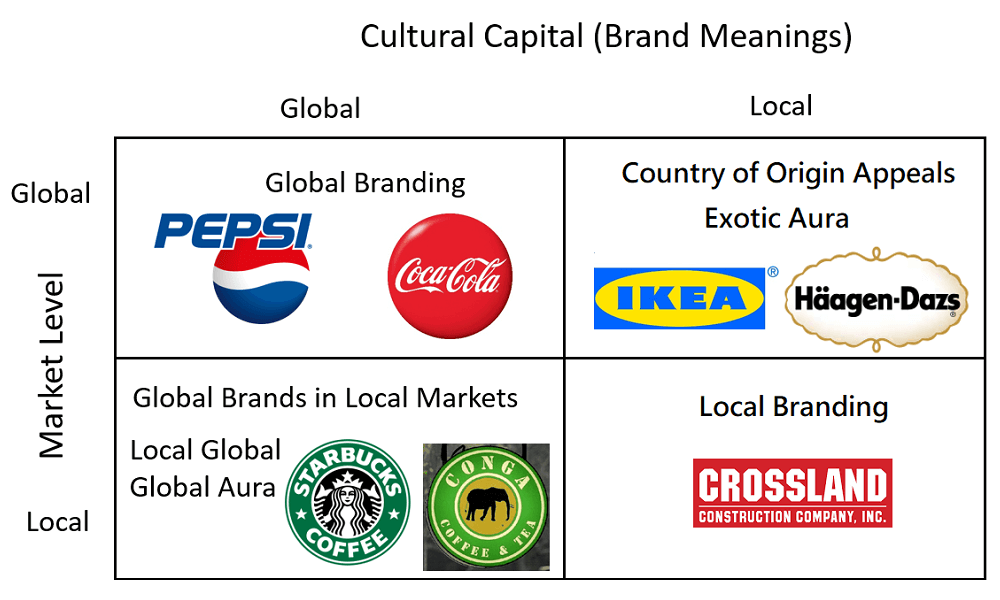
Global Branding: Dimensions
Global Branding involves two dimensions.
- Market Presence/Level: is the brand present globally? i.e. is the brand sold in many different markets that it is perceived as being present everywhere?
- Brand Image/Meaning: is the brand’s image perceived by consumers as being global? i.e. does the brand draw from global symbols in its communication?
Global Branding
This is the traditional Global Branding. The traditional dualistic and antagonistic battles between dominant iconic brands such as Pepsi and Coca Cola. Brands utilize their global cultural capital on a worldwide field of competition for power.
Global Brands in Local Markets
These brands are leveraging global cultural capital to capture local markets.
Local Globals: Global companies in local markets. Here the allusion to globalness is used in brand positioning strategies, typically by global or foreign companies that seek to capture local markets and fight off local competition.
Global Aura: Often local companies using global cues. For example, by using English sounding names.
Local Cultural Capital
Local cultural capital is a source of competitive advantage and it is leveraged in the global competitive field.
- Country of Origin Appeal: IKEA as a reference for Swedish style and heritage; it leverages local cultural capital and it is recognized on the global competitive market.
- Exotic Aura: Brand managers can construct symbolism that connotes ‘foreigness’. Brands that do not necessarily posses local cultural capital seek to be perceived as if they do.
Local Branding
These brand leverage their local cultural capital to compete in the local marketplace.
Local branding: It implies a branding strategy in each marketplace that is localized and inconsistent across market. It often emphasises the amount of years the firm has operated in a marketplace, the use of local workers to make products, or the use of local ingredients.
References
Levitt, T. (1983). The globalization of markets, Harvard Business Review, 63(3), p.92-102

Leave a Reply