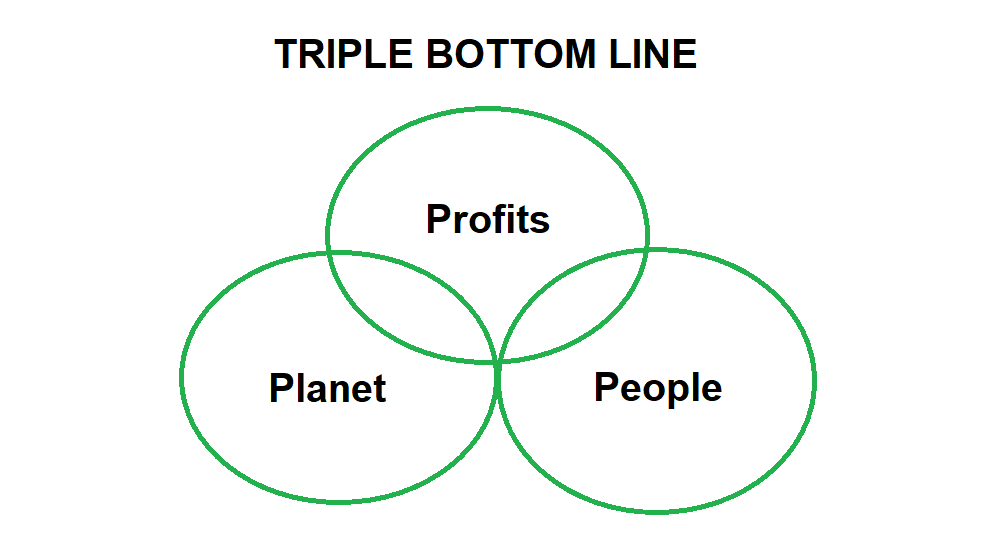
The triple bottom line (TBL) sustainability framework suggests that businesses today should strive to improve in three key areas: making profits, and caring for the people as well as the planet.
The Triple Bottom Line theory focuses on social, environmental, and financial sustainability. By focusing on these three areas, it is possible to create a business model that generates profits while also benefiting society and the environment.
For example: In Mumbai, there is a need for affordable and sustainable housing. By using 3D printing technology, it is possible to reduce construction costs, which in turn can make the housing more affordable. In addition, 3D printing technology can also reduce waste and increase efficiency, which can benefit the environment. Finally, by providing affordable and sustainable housing, it is possible to improve the social well-being of the community.
The term Triple bottom line (TBL) was coined by John Elkington in 1994. TBL is an accounting framework with three parts: social, environmental and financial.
Many organizations (Nike, Tesco, DHL) have adopted the 3BL framework to evaluate their performance in a broader perspective.
TBL is also commonly known as the three Ps: people, planet and profits.
3BL economic (Profit) measures
Economic variables ought to be variables that deal with the bottom line and the flow of money.
How, other than in £’s, $’s, or €’s might you measure your Organisation’s economic performance? One could look at income, expenditures, taxes, business climate factors, employment, and business diversity factors.
Specific examples include:
- Innovation (number of new or adapted products)
- Job growth##
- Customer satisfaction
- Personal incomes
- Costs of underemployment (benefits etc.)
- Establishment size
- Establishment churn
- Employment distribution by sector
- Revenue by sector contributing to gross state product
3BL environmental (Planet) measures
The problem with the TBL concept is that while profit is easily calculated, it is difficult to quantify your people or planet score.
How might you measure your Organisation’s environmental performance?
Environmental variables should represent measurements of natural resources and reflect potential influences to viability. Could be air and water quality, energy consumption, natural resources, toxic waste, etc.
Long-range aims would help organisations identify the impacts a project or policy would have on an area.
Specific examples include:
- CO2 emissions
- Concentration of nitrogen oxides
- Transport-to-work policy (to encourage carpooling/ public transport).
- Travel and expenses policy (to incentivise low-carbon travel or video conferencing).
- Electricity consumption
- Fossil fuel consumption
- Hazardous & solid waste management
- Land use
How might you measure your Organisation’s social performance?
Hint: Social variables refer to the social dimensions of a community or region and could include measurements of education, equity and access to social resources, health and well-being, quality of life, and social capital.
The examples listed below are a small snippet of potential variables:
- Equal opportunity policy
- Recruitment policy & Remuneration policy
- Female labour force participation rate
- Procurement policy (to prefer minority or women-owned businesses, or local suppliers).
- Employee volunteering policy (to create clear EVP frameworks).
- Average commute time
- Health-adjusted life expectancy
- Data for many of these measures are collected at state and national levels, but are also available at the local or community level.
Triple Bottom Line: Summary
Environmental Sustainability: Reduce Pollution. Protect Biodiversity.
Businesses today are expected to care for the environment as they go about conducting their business. There are also several environmental legislations in place that companies are expected to adhere to while doing business.
Social Sustainability: Providing equal opportunities. Preserve inter-generational equity. Health & Safety.
Long-term Economic Growth: Macro-Economic benefits. Take external costs into account (eg, Environmental damage).
Sustainable Development Goals.

Leave a Reply