
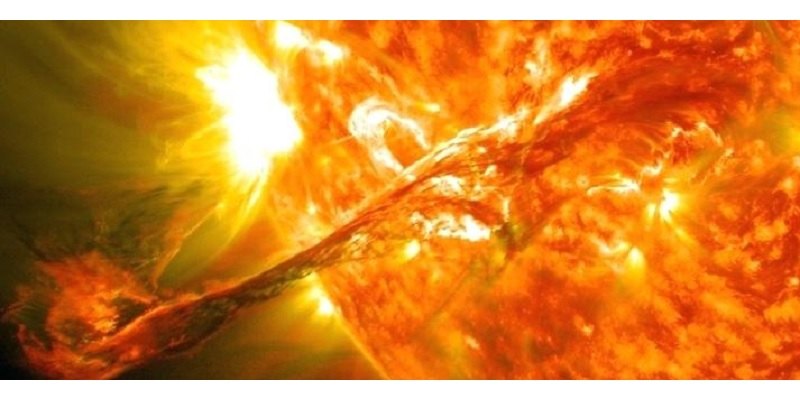
While we all love Earth, its the Sun (the closest star to Earth) that makes life blossom on earth thanks to its light and heat. Without the sun, the earth would be frozen and dark, and there would be no life. Every morning, we welcome a new warm bright day, thanks to the sun.
What is the Sun?
GET INSTANT HELP FROM EXPERTS!
- Looking for any kind of help on your academic work (essay, assignment, project)?
- Want us to review, proofread or tidy up your work?
- Want a helping hand so that you can focus on the more important tasks?
Hire us as project guide/assistant. Contact us for more information
The sun is a huge, spinning, glowing sphere of hot gases at the center of our solar system.
The sun is actually a star which is at the centre of our solar system. It is a hot ball of gases that gives off great amounts of heat.
How was the sun formed?
The sun was born nearly five billion years ago from a cloud of gas and dust called a nebula. The gas and dust swirled around until it thickened into a big ball of gas which became our sun. The leftover gas, dust and rocks became the planets and moons of our solar system.
How does the sun shine?
The sun shines by turning the hydrogen in its core into helium. This process is called nuclear fusion. During this process, enormous energy is generated.
Many cultures worship the sun as a deity or god.
Long back, people from various civilisations considered the Sun as a god, and would perform several rituals to keep him happy (so that he is not angry). Ancient Egyptians had a sun god called ‘Ra’. The Aztecs also had a sun god called ‘Tonatiuh’. The Greeks and Romans also worshipped the sun.
Here are some more facts about the Sun:
- The sun takes over 200 million years to orbit the galaxy.
- The sun is bigger than 1 million earths.
- During their revolutions, when the moon comes between the sun and the earth, a solar eclipse occurs.
- It is dangerous to look directly at the sun without protective glasses.
- Life on earth depends on light and heat from the sun. Without the sun, there wouldn’t be plants, animals and people on our planet Earth.
- We also get solar energy (power) from the sun’s rays.
Solar Energy
Solar energy means light and heat that comes from the sun. Today, scientists are conducting experiments to use solar energy to run cars, air conditioners, TVs etc. Solar energy is free, clean and in plenty.
Isn’t it amazing?
Ancient Greeks built their houses such that the sun’s rays entered during winter but not in summer.
Precautions to be taken when outdoors:
- Always wear a hat when you are in the sun.
- Sunglasses will help to protect you from the harmful rays of the sun.
- Apply plenty of Sunscreeen to protect your screen from harmful rays.
- As much as possible, cover your skin with a shirt if you can.
- Play in the shade for better protection from the sun, especially during afternoon.
Leave a Reply