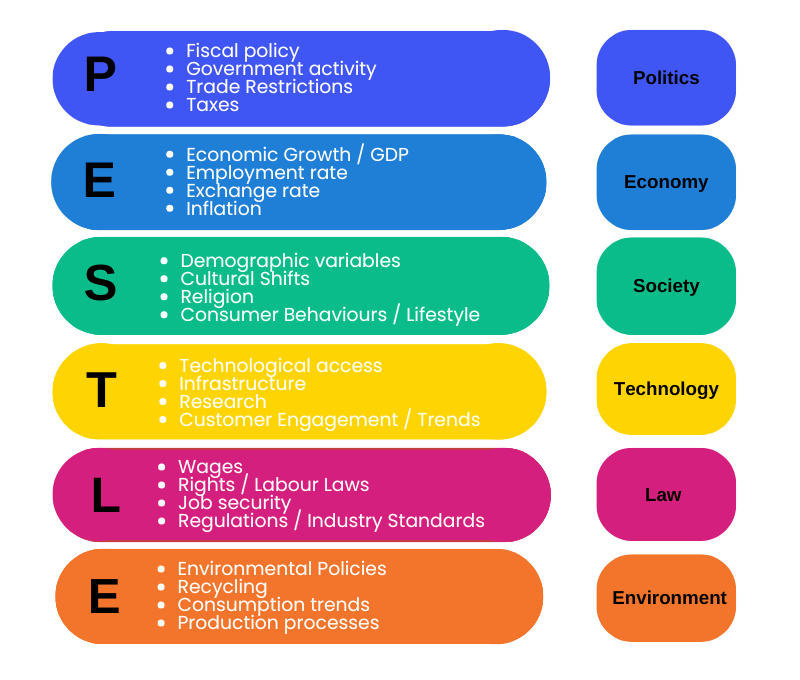
The STEEPLE model is a strategic management tool used to analyze the macro-environment, the opportunities and threats in the external environment. It is an expansion of the well-known PESTEL analysis, and provides a more comprehensive view of the external environment.
The STEEPLE acronym stands for Social, Technological, Economic, Environmental, Political, Legal, and Ethical factors.
- Social: Cultural aspects, demographics, societal values, lifestyle trends.
- Technological: Innovation and advancements in technology that affect operations, products, or services.
- Economic: Macro-level economic forces that influence consumer purchasing power and the cost of capital.
- Environmental: Ecological and environmental factors – climate to sustainability – that influence business decisions.
- Political: Political stability, government policies and foreign trade agreements.
- Legal: Regulatory framework, specific laws, and legal standards that a business must comply with.
- Ethical: Moral standards expected by society, stakeholders, and the public.
While the STEEPLE model may look similar to PESTLE, it is actually an extension. STEEPLE includes all the factors of PESTLE plus one additional, important element: Ethical factors.
PESTLE is the more traditional and more commonly used framework, STEEPLE provides a more contemporary analysis for businesses as stakeholders are increasingly scrutinizing Corporate Social Responsibility (CSR) and ethics.
Examples
STEEPLE Analysis for Indian Handicrafts Market
Social factors: India has a rich heritage of designs and handcrafting skills. As handcrafts are unique and handmade, they tend to be expensive. Modern and cheap electronic products and machine-made goods are replacing handicrafts, especially in gifting. Younger craftsmen are moving to other lucrative fields, creating risk of losing the heritage.
Technological factors: Inequity of education, information and technology ownership, prohibits artisans from competing with established brands. E-commerce platforms like Etsy, Amazon and The Artisan Foundation provide access to Indian and International customers. To maintain ethnicity, artisans use indigenous tools in production instead of advanced technology, which keeps volumes low.
Economical factors: Handicrafts Industry is a significant employment generator in India. India is one of the largest handicrafts exporters globally. The Covid pandemic had serious adverse impact on handicrafts industry.
Environmental factors: Handicrafts sector works on a self-sustaining business model, artisans employ environment-friendly, zero-waste practices. Natural ingredients are used to make handicrafts. Artisans also recycle and reuse everyday items, encouraging circular economic methods.
Political factors: Indian Government has schemes/initiatives to support craftsmen such as National Handicraft Development Program. Artisans have to pay GST on raw materials and finished products, making handicrafts expensive and hurting demand.