Shivaji Maharaj (GK, Quiz, MCQ). Let’s test your general knowledge and see how much you know about the great Maratha warrior.
About Shivaji Maharaj
Shivaji Raje Bhosle was born to Shahaji Raje and Jijabai on 19th February, 1630, at the hill fort of Shivneri in Pune. He was named after the goddess of the region, Shivai.
With a will to establish Swaraj, Shivaji Maharaj set up his own army of Mavlas. Gathering his small army, he first captured the Torna fort of the Bijapur kingdom when he was only 16 years. He then went on to capture and rebuild several forts.
Shivaji Maharaj’s teacher, Dadoji Kondodev often told stories about brave soldiers and heroes. This left a deep impact on Shivaji Maharaj’s mind and he grew up being a thoughtful, clever and brave king who respected people of all religions.
With his bravery and intelligence, Shivaji Maharaj built a powerful Maratha army and took control of several forts. During his rule, the British, Dutch, Portuguese and Mughals controlled the western shores. Shivaji Maharaj realized the need of a naval force to get back the shores. In 1665, Shivaji Maharaj became the first native ruler to build his own naval force. He is thus known as the ‘Father of the Indian Navy’.
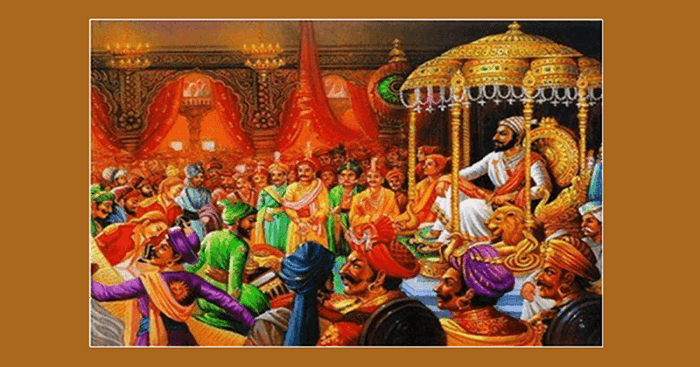
Shivaji Maharaj was crowned ‘Chhatrapati’ on 6 June, 1674 at Raigad fort. The word Chhatrapati can be split into two namely Chhatra (roof or umbrella) and Pati (master, owner or ruler). Therefore, the term Chhatrapatirefers to the one who takes care of his people, protecting them from above like an ‘umbrella.
The great escape from Aurangzeb’s clutches
Here’s an interesting chapter from the pages of history – Shivaji Bhosale’s great escape from the clutches of Aurangzeb after the later had put Shivaji Maharaj under house arrest.
Shivaji Maharaj found great success against the Mughals using his guerilla tactics, much to the dismay of Aurangzeb.
After Shivaji defeated Shaista Khan (Shayista Khan), in 1664, Mughal emperor Aurangzeb sent a strong force of 10,000 soldiers under the leadership of Maharaja Jai Singh, one of his ablest commanders and diplomats, to defeat Shivaji.
Jai Singh captured several of Shivaji’s forts and his army then attacked the fort of Purandar where Shivaji was residing. Facing defeat, Shivaji signed a treaty of peace under which Shivaji would have to hand over 23 out of 35 forts to the Mughal emperor.
Jai Singh suggested that Shivaji personally accompany him to Agra to meet Aurangzeb for sanctioning the treaty; he assured his safety. The Mughal emperor also sent a letter on April 5, 1666, to Shivaji saying that he will be treated royally on arrival.
Shivaji, accompanied by his son, and a small force reached Agra on June 11, 1666. The Prime Minister, Asad Khan led Shivaji and his son to the Mughal durbar where both Shivaji and his son offered the customary nazar to the emperor.
Then both were taken back and asked to stand in the third row of nobles/courtiers. This angered Shivaji (Aurangzeb had promised to treat him royally) who complained about the breach of the terms.
An enraged Aurangzeb ordered Shivaji’s house arrest for three months (he was not allowed to leave Agra). Some say that the plan was to move Shivaji to a secluded place where he could be easily killed.
Under house arrest, Shivaji started plotting his escape. He pretended to be ill and told the Mughals that he was suffering from several stomach ache. After a three-day treatment by doctors, Shivaji was declared fit.
Shivaji requested for sweets and money to distribute among doctors, Brahmins, and the poor. Sweets made in huge quantities were sent out in bamboo baskets; these were strictly checked by the guards initially. However, after a few days, the security guards became more relaxed. It is said that Shivaji had bribed a few Mughal officers as well, to not check all the sweets baskets.
Taking opportunity of this lax approach of the guards, on August 19, 1666, Shivaji along with his son escaped by hiding inside the huge baskets of sweets. Its believed that before escaping, Shivaji dressed up two of his courtiers like himself and his son to avoid suspicion.
Once Shivaji and his son escaped, instead of going to Maharashtra, they moved towards Mathura where Shivaji shaved off his beard and mustache, applied ash on his face, so that he looked like a Sanyasi (hermit). From Mathura, the father-son went to Prayag (Allahabad), Banaras and then to Bundelkhand (Madhya Pradesh) and then to Golconda (Andhra Pradesh) and finally reached Raigarh in Maharashtra in October 1666, after a journey of almost 60 days.
GK (General Knowledge) Questions on Shivaji Maharaj
Q) Who is considered the founder of Maratha empire?
Answer: Shivaji Maharaj
Q) Where was Shivaji Maharaj born?
Answer: Shivneri
Q) Where is Shivneri fort located?
Answer: Near Junnar in Pune district in Maharashtra
Q) In which year was Shivaji born?
Answer: 1630 (February 19, 1630)
Q) Shivaji belonged to which Maratha clan?
Answer: Bhosle / Bhonsle (popular surname among Maharashtrians)
Q) What was Shivaji’s father’s name?
Answer: Shahaji
Q) What was Shivaji’s mother’s name?
Answer: Jijabai
Q) At the age of 12, Shivaji went to see his father in which city?
Answer: Bangalore (Bengaluru).
His father Shahaji Raje then ruled Bengaluru. Shivaji stayed in Bengaluru for a few years, as per this report.
Q) Who was the 1st wife of Shivaji?
Answer: Sai Bhosale
Q) In which year Shivaji became Chhatrapati?
Answer: 6 June 1674, at Raigad.
Q) What does Chhatrapati mean?
Answer: Royal Title equivalent to the title ‘King’ or ’emperor’.
The Sanskrit term combines Chatra (umbrella) with Pati (master), and means the one who protects his subjects.
Q) Who was Shivaji’s guru?
Answer: Samarth Ramdas (saint and spiritual poet)
Q) When was the Battle of Pratapgarh fought?
Answer: November 10, 1659.
Fought between Shivaji and the Afzal Khan at ‘Fort of Pratapgad’ (near Satara). The battle is still remembered for the manner in which Afzal Khan was killed by Shivaji. It was the first major Maratha win against a regional power, leading to the establishment of the Maratha Empire.
Q) Which taxes were introduced by Shivaji
Answer: Chauth and Sardeshmukhi
Q) Treaty of Purandar (Purandhar) was signed between which parties
Answer: Jai Singh and Shivaji
The Treaty of Purandar was signed on June 11, 1665, between Rajput ruler Jai Singh I (who was commander of the Mughal Empire) and Shivaji Maharaj. Shivaji was forced
to sign the agreement after Jai Singh besieged (surrounded) Purandar fort. Shivaji, realizing that war would inflict huge damage on his forces, chose to make a treaty instead of leaving his men under the Mughals. Shivaji had to make several compromises, and even had to agree to visit Agra to meet Aurangzeb for further political talks.
Q) In which year was Shivaji captured by Aurangzeb?
Answer: 1666
In 1666, Aurangzeb invited Shivaji to Agra, along with his nine-year-old son Sambhaji. On 12 May 1666, in the court, Aurangzeb made Shivaji stand behind military commanders, which offended Shivaji and he stormed out of the court in protest. Shivaji was promptly placed under house arrest (Shivaji eventually managed to escape).
Q) In which year did Shivaji die
Answer: April 3, 1680 (Shivaji died of illness at the age of 50, he died in Raigad Fort, Pune)
Q) Shivaji died on the eve of
Answer: Hanuman Jayanthi
Q) Whose statue was erected alongside Shivaji’s memorial?
Answer: Shivaji’s pet dog.
Legend has it that Waghya (the pet dog) was distraught at the sight of his master’s funeral and lept onto the burning pyre thus killing himself. In 1936, a statue of Waghya was erected at the site of the burial at Raigad (a rugged mountain fort that was Shivaji’s capital).
Q) Shivaji’s son’s names?
Answer: Sambhaji Bhosale, Rajaram Bhosale
Q) Who was the successor of Shivaji?
Answer: Sambhaji
That’s all we have here!
Do you think we missed any General Knowledge question on Shivaji Maharaj that should be listed here? Feel free to comment and we will have it added.

Leave a Reply