Introduction to marketing: Various definitions, marketing mix, sales vs. marketing, marketing plans, and more.
What is Marketing?
Marketing is a tool that companies use to sell their products and services. It refers to the various techniques and strategies that companies use to make a product more appealing to a prospective buyer.
Marketing is an organizational function and a set of processes for creating, communicating and delivering value to customers and for managing customer relationships in ways that benefit the organisation and its stakeholders.
Over the years, these strategies have undergone changes, based on the change in the business environment, based on knowledge acquired about the consumer decision making process, and based on other factors/drivers such as technology, concern for the environment and so on.
Marketers are skilled at managing demand: they seek to influence the level, timing and composition of demand. Marketers are involved in marketing many types of entities: goods, services, events, experiences, people, places, properties, organisations, information and ideas. They also operate in four different marketplaces: consumer, business, global and not-for-profit.
More Definitions
Marketing refers to the processes employed by a firm in order to identify and satisfy the requirements of the customers in order to generate profits for the firm. It is about meeting needs & wants, creating utility & value and building exchange relationships.
Marketing refers to the activities and processes for communicating messages and delivering offerings that have value for customers and even for the society at large.
Strategic marketing
Strategic marketing is what is being carried out by a business that has clearly documented marketing strategy that is guiding all its marketing activity. It covers things like Mission, Vision and Values, Objectives, Target audience, Competitive Positioning. Strategic marketing helps an organisation differentiates itself from the competition so that it can provide better service and value to its customers.
Marketing management is the process of planning and making strategies to promote a business. It is the art and science of choosing target markets and getting, keeping and growing customers through creating, delivering and communicating superior customer value.
The Development of Marketing
Marketing has its origins in the market society although evidence of commerce and marketing were evident in ancient civilisations.
It was in the 1950s that firms started using Marketing to focus on the customer’s needs.
- Production period, 1890s-1920s: This period was characterized by a focus on physical production and supply, where demand exceeded supply. This phase took place after the industrial revolution.
- Sales period, 1920s-1950s: This period was characterized by a focus on personal selling supported by market research and advertising. This phase took place after the First World War.
- Marketing period, 1950s-1980s: This period was characterized by a more advanced focus on the customer’s needs. This phase took place after the Second World War.
- Societal marketing period, 1980s to present: This period was characterized by a stronger focus on social and ethical concerns in marketing. This phase is taking place during the ‘information revolution’ of the late twentieth century.
Importance of Marketing
At the most basic level, marketing helps a business create awareness about its products. It also plays an important role in the exchange of Goods in the market as it ensures that everything that the community requires is delivered to them. Marketing plays an important role in the society as it helps shape people’s social lives.
Here are some of the functions of Marketing:
- Provide market related intelligence and insights about the target segment
- Provide strategic marketing direction for the organization
- Develop the product/service proposition for the customer
- Manage and provide marketing communications
- Lead marketing programmes, work closely with other business functions and agencies
Marketing in Context
The Consumer Goods Perspective – Bucklin (1963) defined consumer goods as convenience goods (purchased frequently, minimum effort), shopping goods (purchased selectively), or speciality goods (purchased highly selectively).
The Services Perspective – Services marketing thinkers suggested that the intangible performance-dependent nature of services substantially affected the way they should be marketed (Shostack, 1977).
The Business-to-Business Perspective – B2B marketing is different from consumer marketing because the customer is a professional buyer within a business and not really an individual.
Marketing Planning
Marketing Planning is the process of analysing marketing environment/situations, deciding marketing objectives, and implementing various marketing strategies to achieve those objectives.
It involves assessing the internal environment to understand if a company possesses the capabilities and requirements to successfully launch a new product range. It also assesses the influence of the external environment on the industry, which could impact business from the new product range.
This involves undertaking market research (can involve both primary and secondary research) to understand market size, trends. 4P (or 7P), competitor analysis is done.
The importance of researching the target market is critical before planning a marketing campaign. A good understanding of those who are more likely to use the goods or services is vital so that marketing can be more effectively directed at them.
Finally, marketing strategy (with budget and KPIs to measure success) is created to promote the new business/product line.
Read more on Marketing Planning here.
Marketing Strategy vs. Marketing Plan
Marketing Strategy is an explanation of the goals you need to achieve with your marketing efforts. Your marketing strategy is shaped by your business goals. It consists of the “what” has to be done.
Marketing plan is how you are going to achieve those marketing goals, a roadmap that will guide you from one point to another. It consists of the “how” has to be done.
Here’s an example:
Business Objective: To gain broader market adoption.
Marketing Strategy: Introduce into new market segments.
Marketing Plan: Develop a marketing campaign that reaches out, identifies with and focuses on that specific segment.

Marketing Mix
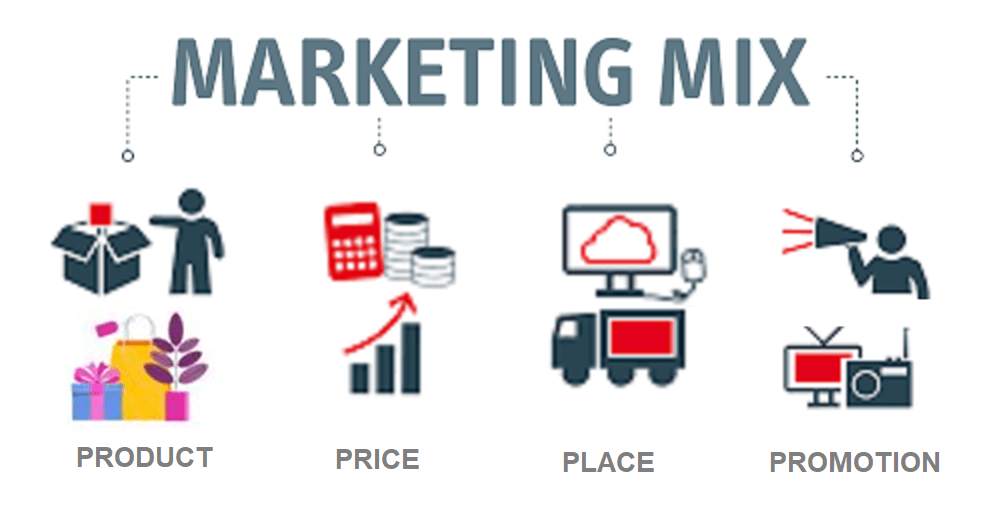
Marketing Mix refers to the use of marketing tools in a tactical manner so as to produce the desired response from the target market. The various elements of the marketing mix include Product, price, promotion, place, people, physical evidence and process.
The marketing mix is commonly executed through the 4P’s of marketing (Price, Product, Promotion and Price), buy may include additional Ps such as packaging, positioning and people depending on what is being marketed.
Segmentation – Targeting – Positioning (STP) Process
The STP marketing model is a commonly used strategy in modern marketing.
- Segmentation: divide market into different segments based on customer characteristics.
- Targeting: select one or more segments based on suitability.
- Positioning: develop products to meet the needs of specific segments.
Target Marketing Strategies
The different target marketing strategies used by firms include:
- Undifferentiated (mass) marketing: One product offering to entire market.
- Differentiated marketing: Different product offerings to two or more target segments.
- Concentrated marketing: One product offering to one (niche) target segment.
- Customised marketing: A customised offering to each individual customer.
Social Marketing
Social Marketing refers to the use of marketing to encourage social change. Here, the commercial marketing technologies are adapted to influence consumer behaviour that will improve social welfare. Unlike commercial marketing, social marketing is aimed at benefitting the society and not on making a profit.
Related: Digital (Social Media) in Marketing
Marketing in the Experience Economy
The Experience Economy refers to a paradigm shift where consumers are giving more importance to experiences over goods and services. This concept, introduced by Pine and Gilmore explains the progression of economic value from commodities to goods, services, experiences, and ultimately, transformation.
Leave a Reply