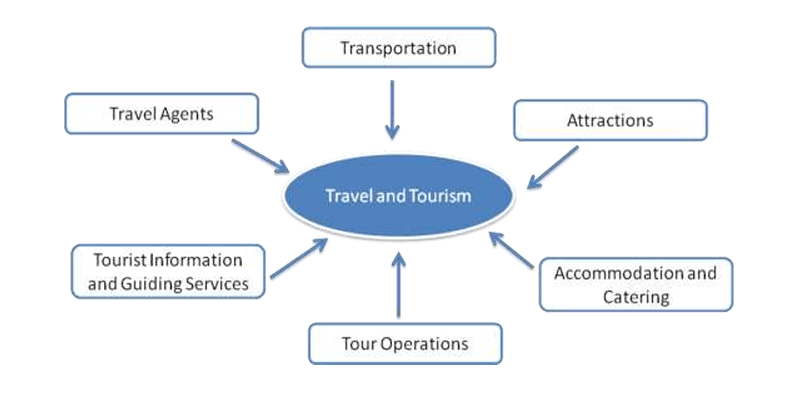
Hospitality industry is a service industry that refers to hotels and organisations providing food and beverage and accommodation services to their guests. Their ultimate goal is customer satisfaction.
Tourism is growing rapidly that offers many exciting careers in today’s upcoming field. The top hotel management colleges provide enhanced and quality education in hospitality, catering, and related fields of study, to the budding managers and chef’s of tomorrow.
Hospitality education delivery is designed in such a way that students get to immediately apply what they have learned in classrooms in a live hotel environment. It helps students turn into professional leaders capable of making decisions in global environment.
History of Hospitality
The term Hospitality is derived from a French word “Hospice” which means ‘Taking care of the travellers’.
- In the middle ages the Greeks and Romans built thermal baths and spas for the purpose of rest and relaxation.
- The 16th-17th century marks the beginning of the hospitality industry when laws were introduced to govern hotels.
- In the 18th-19th century lodging along with food and drinks were provided to the travellers.
- Modern hospitality began in the 20th century and emerged as a huge business opportunity for many countries.
- In the 21st century, Hotels are becoming more advanced due to use of technology.
Today, Hospitality industry is one of the fastest growing industries in the world, and creates employment opportunities for billions of people.
Hotel Grading & Classification Systems
Hotel grading or rating is often used to classify hotels according to their standards and services offered. Rating or grading systems may differ from region to region. Star rating is the most commonly used rating system globally. Forbes Travel Guide, Michelin Star Guide, etc. are other rating systems used today.
ONE STAR HOTEL: Offers only the essentials. Modest rooms with an attached bathroom.
TWO STAR HOTEL: Simple and basic accommodation. Offers an on-site restaurant or dining area. Front desk is usually open 24/7. May offer housekeeping services.
THREE STAR HOTEL: Professional staff. 24/7 room services. More upscale and comfortable rooms. Offers an on-site restaurant open for guests and non-guests. Has more professional staff.
FOUR STAR HOTEL: Spacious rooms with luxury touches. Offers special services and amenities. Fine dining open to everyone. Concierge services are available.
FIVE STAR HOTEL: Luxurious rooms with unequalled comfort. Speedy, around-the-clock room service. Offers gourmet restaurants open to everyone. Provides personal butler services. Highly trained and professional staff. Opulent facilities and amenities available.
Front Office Operations
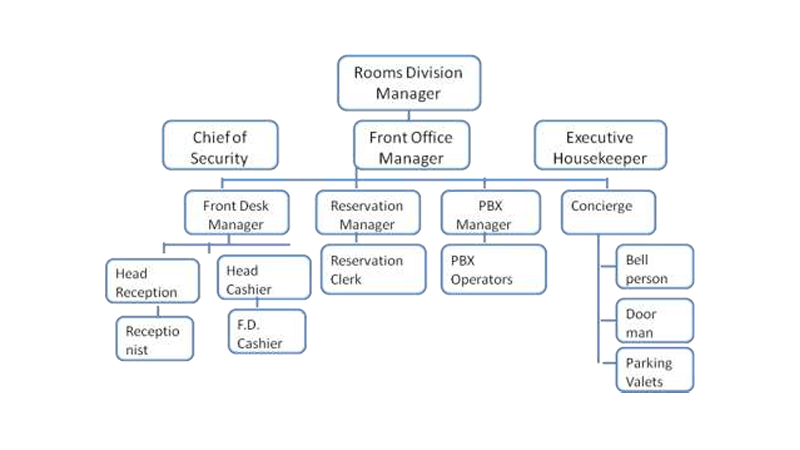
The Front Office acts as the public face for any hotel. All the transactions and communication usually pass through the front office. Front office comprises of functions such as front desk, reservation, PBX, uniformed service, concierge that help create a positive experience for guests.
The Front Office employs people such as the Front office manager, Rooms division manager, Receptionist, Front Office Cashier, Night auditor, Reservationist, Guest Relations Officers (GROs), Concierge, Porters, Switchboard Operator.
Front Office works closely with security department to follow regular investigation of guest security procedures, fire safety measures and emergency communication systems. The General Management team plays an active role in coordinating activities between the front office and other departments such as Housekeeping, Kitchen, Restaurant and Porters. Each of these departments contribute towards the work of the Front office by effectively communicating with each other.
The guest cycle includes all the physical contacts and financial exchanges that a guest has with the hotel, right from the moment the guest check-in through to checkout and final reconciliation of the account. It includes the pre-arrival phase, Arrival phase, Occupancy phase, Departure phase.

Customer’s varying needs cycle states that customers expect their basic amenities to be met, they expect to be greeted in a friendly manner, they expect staff to be more empathetic and fair, they expect more control over the proceedings, they want more options, and want more information about the various services.
Manual and electronic systems are used in reservation, reception, and cashiering functions to process reservation requests, to get the best rates for the rooms, to create uniformity in bookings, and to charge guests with minimum error. The use of electronic increases efficiency, accuracy, and helps in integration of various functions.
Check-in procedure involves completing registration of customers and capturing all necessary information and allocating room to customer. Many hotels also provide self-check-in option. VIP guests have special requirements such as security, confidentiality, pre-registration.
Checkouts can be the conventional (in person) check-out, Express check-out, or In-room check-out/Self-check-out. Check-out procedure involves steps to charge the customer as per different payment methods. Departure related services such as wake-up call, assistance with luggage, airport transfers may be offered.
Banking procedures: All banking transactions are noted and the earnings deposited in bank as soon as possible. Bank reconciliation helps to make sure that financial records of the hotel matches with the bank statement. Night auditors also check if all the accounts are matching by verifying account balances.
Housekeeping Operations
The housekeeping and accommodation department cleans and maintains the rooms and gives an artistic appeal to the accommodation. It ensures the customer is comfortable and happy with the stay.
Housekeeping encompasses different tasks such as: Making beds, Vacuuming and cleaning rooms, Removing stains, Washing floors. In traditional cleaning, an employee finishes all cleaning tasks in a room before proceeding to the next one. In Block style of cleaning, different cleaners do different tasks in each room.
The Executive Housekeeper reports to the Resident Manager who reports to the General Manager. The Housekeeper and Laundry Manager report to the Executive Housekeeper. These Managers have their respective teams to manage Housekeeping and Laundry. The size of the team depends on the number of rooms to be managed.
The linen cycle shows how linen moves through the hotel, it is the duration from when the linen is soiled to the linen is cleaned. A Linen attendant sends out and receives laundry and dry-cleaning items daily, performs weekly and monthly stock-takes for the linen room, carries out linen repairs, organizes staff laundry and dry-cleaning, and communicates with the linen and laundry room manager, floor housekeepers, and housekeeping office co-ordinator.
Standards of furnishing: The choice of furniture depends on factors such as the standard of the hotel, size of the rooms, use and necessities. Hotels tend to have theme based rooms, and the furnishing is based on the theme.
Fire safety and security: Hotels must provide a safe environment for customers and the workers. The rooms and passages are adequately equipped with sound alarms and fire extinguishers. Fire exit signs are placed at important places throughout the property. In the bar area there are enough security staff to assist client to the fire exit. Adequate training is given to the employees on secure working practices and what to do in case of an emergency. The Maintenance Engineer ensures that a hotel’s physical systems and equipment such as fire alarms, fire extinguishers, are well-maintained and in proper working condition.
Developing environmental-friendly policies: A hospitality or tourism business could develop environmental-friendly policies by creating clear environmental guidelines, providing training to employees, creating awareness among employees as well as customers. It must lay down clear procedures for recycling, use of energy efficient equipment, and waste disposal methods.
Food and Beverage Operations
A food service involves offering a wide range of cuisine styles and beverages. Good operations require good product knowledge, food and beverage technicalities, and good interpersonal skills. Good meal experience is about offering good quality food and beverages, serving the food nicely. It requires a professional catering staff with attention to presentation and service.
A food production system helps produce the right quantity of food for the required number of people, maintaining the requisite quality and standard, using resources effectively.
Different methods of cooking including Blanching, Broiling, Frying, Deep Frying, poaching, Stewing, Boiling, Steaming, Grilling, Saute, Baking, Roasting. Presenting the food requires things like trays, plates, dishes, trolley, etc. The things needed to present this food include plates, dishes, trays, trolley, etc.
Various service types include Table service where customer is served at the table, Self-service in which customer serves themselves, Assisted Service, Single point service in which the customer pays and receives food over the counter, Specialised service.
Types of food and beverage industries
COFFEE SHOP: Mostly operational 24/7. Provides an A La Carte menu. Serves local and international dishes. Open to everyone, in-house residents as well as locals.
BAR: Provide some form of live entertainment for the guests. For example- Live music by a guitarist, drummer and a singer. Serves bar snacks, liquor, cocktails, mocktails, soft drinks and cigars. Usually operational from mid-day till mid-night.
LOUNGE: A place to sit and relax for guests. Usually open 24/7, does not have any time restrictions. Serves hot and cold beverages along with snacks and desserts.
FINE DINING: Cuisine and service is expensive and leisurely. It has a sophisticated atmosphere. It provides high quality and variety of food. Most 5-stars hotels have fine-dining.
MINI BAR (In Rooms): A mini refrigerator in a hotel room containing cold alcoholic and non-alcoholic beverages. It can be used anytime. It’s a paid service, customers pay for the items consumed. Usually available in 4-star and 5-star hotels.
Destination Analysis
Destinations are places of interest for visitors who visit such places for a temporary stay. Tourist destinations can be cities, villages, countries, continents, natural attracts or purpose built resort areas.
Inherent and secondary features make a tourist destination attractive to visitors. Inherent features include things like climate, traditional architecture, culture, history, religion and geography. Secondary features include features such as ease of transport, availability of hotels, events and other activities.
Social and cultural features of a destination include things like Language, Religion and beliefs, Traditional lifestyles, History, Architecture, Festivals, Art & Craft, Music & Dance, Education/literacy, Value, Local Traditions.
Political features include things such as government policies and measures to promote culture, develop infrastructure and amenities in order to support tourism and hospitality.
The social and cultural features of Goa is different from that of Ayodhya. Government of Goa promotes Goa as a leisure destination. UP government promotes Ayodhya for religious tourism. Both destinations have support from the state government to develop tourism.
Tourism Area Life Cycle (TALC)
Similar to how products go through a life cycle, even tourist destinations go through a cycle that is known as the Tourism Area Life Cycle (TALC).
TALC represents the various stages of the life cycle of a destination, such as Exploration in which some tourists first discover a destination, Development in which there is rapid growth in tourism due to investments in Infrastructure, Stagnation in which a destination faces challenges such as overcrowding or changing preferences of visitors, and Rejuvenation / Decline where the destination faces a decline or may consider rejuvenating itself through planning. TALC helps destination planners to plan better to address challenges associated at each stage in order to ensure long-term sustainable growth of a destination.
Travel Agency
Hospitality and travel industry include unique intermediaries such as travel agents and tour operators, and the services offered by them tend to be intangible. The role of travel agent, operators and tourism-related stakeholders is to provide consumers information about national and international tours, and to sell accommodation, transport, and related activities. Tour guides lead tourists around popular attractions at a destination.
A Travel Agency works as a broker for various suppliers such as hotels, car rentals, and tour companies. It brings together buyers and sellers of various services within the tourism industry. A Travel Agency performs several sales, marketing, and administrative functions related to travel and tourism. Different types of travel agents include leisure travel agents, business travel agents, and speciality agents that serve niche market segments such as adventure travellers, religious travellers and so on.
Laws in the travel industry exist to protect the best interests of customers as well as those offering services in the travel and tourism industry. Travel agencies are bound by different laws such as contract law, employment law, anti-trust rules, regulatory and agency compliance.
A successful tour has the following features. It includes everything that a tourist wants to do. Everything is planned and happens on time. The tour operator is knowledgeable and provides all relevant information to the traveller. The travellers feel that they have got value for the money that they have spent.
The travel industry faces transport related issues. Large number of tourists results in huge traffic at the destination and can also cause accidents. Increased consumption of fuel results in environmental damage. Often, the transport providers quote exorbitant prices for offering services. In the last few years, Manali which is the scenic hill state of Himachal Pradesh has been receiving thousands of vehicles before New Year which results in chocked roads and massive traffic jams.
Internal and External Factors
Internal and External factors can have an impact on the success of Hotels.
- Internal Factors: Use SWOT, VRIO, Resource based view.
- External Factors: Use PESTLE, Porter’s 5 forces
Case Studies
The Ordinary Heroes of the Taj Hotel
Taj terror attack has become a massive psychology case study in Harvard. Not ONE Taj employee abandoned the hotel and ran right through the attack. They helped guests escape and many died . 1100 guests, 600 employees. Over 1600 managed to escape safe. Only 34 people died, of which half were staff members.
Probably defense personnel are trained to deal with such situations. May be some in the police may also show courage and stay put. But employees in a city like Mumbai staying put when terrorists have entered their premises?
It confounds psychologists.
The speaker talks about 3 recruitment strategies.
1) Taj did not recruit from big cities , they recruited from smaller cities where traditional culture still holds strong
2) They did not recruit toppers, they spoke to school masters to find out who were most respectful of their parents, elders , teachers and and others .
3) They taught their employees to be ambassadors of the guests, to become their ears to the organisation, and not to become ambassadors of the company (which is usually the norm).
Projects & Assignments on Project Management
Select a hospitality or tourism organisation and prepare a report discussing the vision, mission and values of the organisation, its target market, competition, product range, customer service standards, and develop recommendations for this particular organisation. Conduct relevant and adequate primary and secondary research on the chosen organisation. Students are encouraged to interview members of the selected organisation.
Include the following related to the selected organisation:
- Introduction to the organisation: Introduce the vision, mission and values of the organisation. Identify the target market of the organisation.
- Identify the competition of the organisation. Identify the range of products sold by the organisation and their prices.
- Customers’ needs and wants: Introduce the customer service standards of the organisation. Identify areas where customers’ needs and wants are/are not met.
- Findings, Conclusions and Recommendations: Analyse the findings of the research. Draw conclusions. Make recommendations.
Students should demonstrate application of theory and knowledge. The analysis should be concluded with detailed and well-justified recommendations; relevant examples can also be quoted. Students must then prepare a presentation on how they conducted the research process. The report must begin with an introduction and finish with a conclusion and recommendations.

Leave a Reply