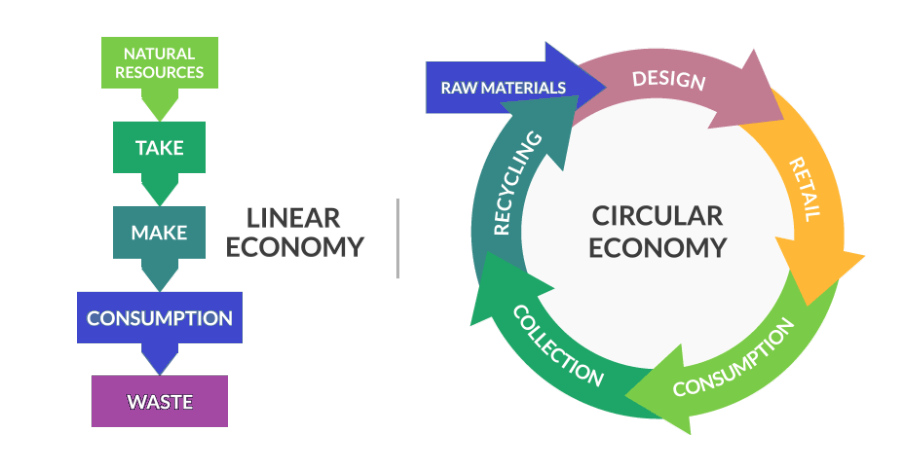
A linear economy is the traditional economic model in which consumers buy a product, use it, and disposes it. There is little emphasis on reuse, repair, or recycling.
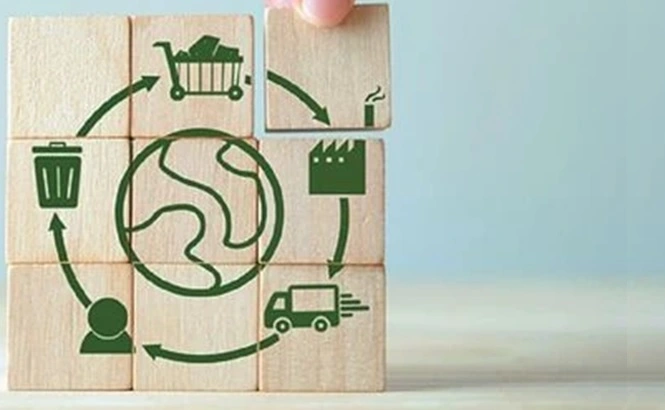
A circular economy is an economic model that emphasizes sustainability and resource efficiency. In a Circular Economy, the idea is to create sustainable products that keep resources in circulation as long as possible and as much as possible.
Circular Economy uses the principles of Systems Thinking, where the Lifecycle of Material & Energy flows form the foundation to come with useful solutions – Both Upstream & Downstream.
12 R’s Of Circular Economy
The 12 Rs of Circular Economy are strategies that guide businesses and individuals to reduce waste, keep materials in use, and regenerate natural systems, reducing reliance on virgin resources.
In order of priority these strategies are: Refuse, Rethink, Reduce, Reuse, Repair, Refurbish, Remanufacture, Repurpose, Recycle, Recover, Re-design, Re-skill, and Re-vision.
Refuse
Frugal lifestyles. Consume only for basic needs, & not Wants.
Example: eco-dome made of 90% earth & 10% cement. Helps conserve resources needed to produce cement.
Re-design
Plan for making changes to the structure & functions of a product or system so as to better serve the original purpose of the design. The idea is to make durable products, that are not toxic, & can be disassembled & easily repaired.
Examples:
- Kitchen fronts from recycled plastic bottles by Ikea.
- Clay refrigerator running without electricity.
- Hemp, as an alternate textile fabric.
Reuse
Using an object as it is once again, without conducting any significant repair on the product. It includes anything that is bought second-hand.
Examples: reusable packaging, second-hand furniture.
Repair
To put something damaged, broken or not working correctly back into good condition or make it work again.
Examples: greensole, repair of mobile phones.
Renovate
To restore something to a newer or better state.
eg, generally applicable to built structures such as housing, commercial buildings, & public places.
Recycle
Turning an item into raw materials that can be used once again, usually for a completely new product or process.
eg, recycling of pet bottles.
Recover
Waste is converted into resources (such as electricity, heat, Compost, & fuel) through thermal, mechanical, chemical, & biological means.
Examples:
- Facebook’s data center, powered 100% by renewable energy. Facebook partnered with a local heating company; the heat generated by Facebook’s data servers is pumped directly into the district’s heating system, instead of releasing to the atmosphere.
- Recovery of nutrients from organic material through composting.
Return
Take-back of products & packaging after use as a responsible manufacturer. eg, reusable mugs.
Remanufacture
Rebuilding a product to specifications of the original manufactured product using a combination of reused, repaired, & new components. It is the only end-of-life process where used products are at least to the original equipment manufacturer’s performance specification.
From the customers’ perspective, & at the same time are given warranties equivalent to those of new products.
Examples:
- Catterpillar ‘cat reman’ remanufactures used equipment back to same specifications as a new one. Helps reduce operating costs.
- Xerox ‘take-back’ end-of-life copiers, printers, scanners from customers; creating a remanufacturing & parts reuse programme that forms the foundation of waste free initiatives.
Rethink
Thinking out-of-the-box to innovate. Innovations need not limit to materials or design, but can include business models & policy instruments.
Examples: Edible cutlery; alternative meat; bags made out of Casava – an edible root.
Circular Business Models
Circular Business Supplies. Businesses don’t have to use virgin raw materials all the time; where possible, they can use recycled materials. They can use alternate raw materials (eg, bio-waste used in cement industry). This also helps reduce ‘total cost’
Resource Recovery. Business can buy waste from other manufacturers, agricultural products, other service industries, & landfills. Material recovery facilities (mrf) include businesses that provide opportunities for waste sorting, recycling or recovery at a scale. Such units may be set up under public-private partnership.
Product-As-A-Service (PAAS) : Buyers are encouraged to lease out the product rather than purchase it outright.
Product Life Extension : Repurposing products once they have been discarded by consumers (eg, repair & refurbishing. Increases resource circulation).
Sharing Platforms Or Collaborative Consumption : Owner sells access to under-utilized assets to customers. Owners are responsible for maintenance & service quality.
Facilitation For Circular Economy As A Service : Providing stakeholder connections through platforms, helping in aggregation (especially waste), reverse logistics, & supporting material management over the life-cycle.
Inclusive Business : Relevant in countries such as India, where the informal sector plays a huge role in waste picking & recycling operations. Ensuring health, safety & livelihoods of waste pickers.
Performance Based Service : Fees provided for the service depend on the success or on delivered service. This incentivizes the service provider to strive for better service.
Hybrid Business Models : Mix of the Various Models described above.