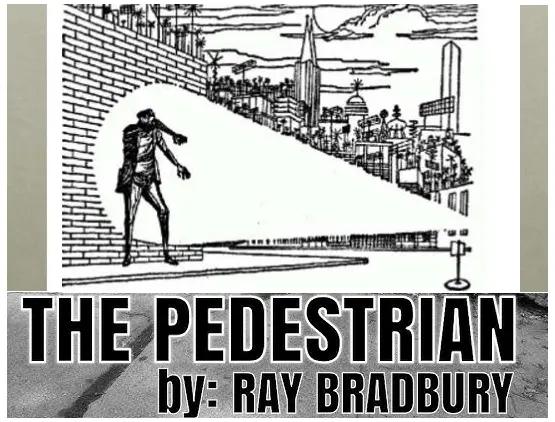
The Pedestrian by Ray Bradbury is a chapter for ICSE students in Class 10. Find summary, notes and answers to questions.
Summary of the Poem
Written by by Ray Bradbury way back in 1950, the Pedestrian is a story set in the future where people spend all their time indoors watching television. The streets are empty, and real human interaction has almost disappeared. The author raises concerns over the technological advancements and how their undue power could destroy humanity.
Leonard Mead, the only person who still enjoys walking outside at night, wanders through the silent city. One evening, he is stopped by a robotic police car—the only one left in the city. The machine questions him suspiciously, simply because walking is now considered strange and unnecessary.
When Leonard explains that he is a writer, the car dismisses his job because no one reads anymore. Seeing him as unusual and “not normal,” the police car decides to take him to a psychiatric centre. The story ends with Leonard being driven away, showing a future where technology controls behaviour and individuality is treated like a crime.
Questions and Answers
Question. Describe the setting. Provide as many details as possible.
Answer: The story is set in the year 2053, in a large American city at night. The streets are completely empty, silent, covered with a thin layer of frost, filled with darkness, except for occasional pools of streetlight. The houses are tightly shut, dark and quiet, glowing only with the flicker of television light from inside. There is no traffic, no pedestrians, and no sound except the noise of Leonard Mead’s footsteps. The city feels cold, lonely, and almost abandoned—even though millions of people live there.
Question. Describe the society in which Leonard Mead lives.
Answer: Leonard Mead lives in a society where: People stay indoors all the time, watching television. Technology controls daily life, including the police. Books, walking, and open conversation have almost disappeared. Social interaction is minimal—people don’t talk or go outside. Human presence is replaced by machines (like the robotic police car). Individuality is discouraged—any unusual behaviour is suspicious. It is a society that values passive entertainment over real human experiences.
Question. Explain the possible reasons that Leonard Mead does not fit into this society. Why does he keep all of his lights on?
Answer: Mead doesn’t fit because he likes to walk outside, unlike everyone else. He is a writer, but in this society no one reads anymore. He values silence, nature, and observation, while others prefer TV. He enjoys freedom and individuality, which makes him stand out.
Mead keeps his lights on because he is different because everyone else’s houses are dark except for television screens. His bright lights signal a home filled with real life, not just TV glow. It symbolizes his awareness, creativity, and active mind in a dull, passive society.
Question. What is the tone of the story? Which repeated words/images help create this tone?
Answer: The tone is lonely, eerie, and dystopian. It feels like a warning about what society could become.Words and images Bradbury repeats:
- Silence / Empty streets – creates a sense of isolation.
- Darkness / Shadows – symbolizes fear and lifelessness.
- Cold / Frost / Chills – suggests a world without warmth or humanity.
These repeated images create a mood that is silent, unnatural, and slightly frightening.
Question. Mead is taken to the Psychiatric Center for Research on Regressive Tendencies. What does “regressive” mean? Why would he be taken there just for walking?
Answer: “Regressive” means going backwards—returning to old habits or earlier ways of living.
In this society, walking outside is seen as old-fashioned, goes against the normal behaviour of citizens, is viewed as suspicious and unnecessary. Because Mead behaves in a way the society has abandoned, he is considered “regressive,” meaning he is not modern, not normal, and therefore a threat.
Question. What might have happened to this society that there would be no crime, but walking would be considered criminal? What is Bradbury suggesting (theme)?
Answer: People are so absorbed in screens that they never leave their homes. Since no one interacts, there are no opportunities for crime. The government uses technology and surveillance to control behaviour. Individual actions outside the norm are treated as threats.
Bradbury warns that too much dependence on technology can destroy human connection, society might value control and uniformity more than freedom, individuality may be punished; when people stop thinking for themselves, society becomes lifeless.
The theme is a warning about the dangers of technology, loss of humanity, and the cost of conformity.
Question: Is “The Pedestrian” by Ray Bradbury a horror story or a piece of science fiction?
Answer: “The Pedestrian” by Ray Bradbury is more of a science fiction than a horror story.
“The Pedestrian” features several dystopian elements, shaped by technology, such as isolated and disconnected individuals, oppressive control and lack of personal freedom where simple acts such as walking at night is seen as abnormal.
However, that doesn’t make it a horror story.
The story talks about the risks and ethical concerns of advanced technology and possible impact on future developments and on the society. The themes align more closely with a science fiction as it speculates the future and the experiences of humans in that world.

Leave a Reply