The two basic types of machines are simple machines and compound machines. The difference between simple and compound machines is that a compound machine is a collection of simple machines working together in tandem. Machines can be simple or complex; simple machines can be combined to form a complex machine
Introduction to Machines: Big & Small
Machines are all around us. They help us do things, or make doing them easier.
See-Saw
Every time you play on a see-saw, you are using a machine.
A lever is a stiff bar that tilts at a point called the pivot or fulcrum. The pivot of the see-saw is in the middle. Using the see-saw as a lever , s small person can lift a big person by sitting further from the pivot.
Screw
The screw is another simple but useful machine.
It is a ridge, or thread, wrapped around a bar or pole. It changes a small turning motion into a powerful pulling or lifting movement. Wood screws hold togethr furniture or shelves. A car jack lets you lift up a whole car.
Wheels
Is it possible to go too far without wheels? The wheel is a simple machine, a circular disc that turns around its centre on a bar called axle.
Wheels carry heavy weights easily. There are giant wheels on big trucks and trains and small wheels on roller-blades.
Pulley
A pulley turns around, like a wheel. It has a groove around its edge or a cable or rope.
Lots of pulleys allow us to lift very heavy weights easily. The pulleys on a tower crane can lift huge steel girders to the top of a skyscraper.
Wedge
A wedge is a triangular-shaped machine (moving inclined plane) that is driven under load. It can be used to separate objects, hold or stop an object, or lift an object. A wedge changes the direction of the input force.
Technically it is an inclined plane (or two inclined planes put together to form a triangle) that moves.
Examples:
Split a log using a sledgehammer (has a wedge)
Cut a fruit using a knife.
A knife is a wedge with an attached handle. Use wedge machine under adult supervision.
Gears
Gears are like wheels, with pointed teeth around the edges. They change a fast, weak turning force into a slow, powerful one – or the other way around. On a bicycle, you can pedal up the steepest hill in bottom (lowest gear), then speed down the other side in top (highest) gear.
Simple Machines
A simple machine is the simplest device that performs work. A simple machine applies a single force to a single load and generally acts as a building block in developing more complex, compound machines. Simple machines usually fall into one of six categories, including: lever, wheel and axle, pulley, inclined plane, wedge and the screw. Simple machines do not contain an energy source so cannot perform more work than is applied to them in their use.
Types of Simple Machines
- A lever is an object that acts as a pivot point that multiplies the force that can be applied to another object.
- The wheel and axle is a rod attached to a wheel which can multiply an applied force.
- A pulley consists of a wheel on an axle with a rope running over the wheel. Pulleys are used to change the direction of an applied force.
- The inclined plane is a flat surface with ends at different heights. Inclined planes reduce the amount of force required to move an object.
- Wedges are triangular-shaped and used to separate, hold or lift an object.
- Screws are cylindrical shafts with grooves that pass through or move other objects through rotational force.

Compound Machines
Compound machines are a collection of simple machines working together. Compound machines are the most common type of machine and do more complex work than individual simple machines. They perform more work and therefore offer a greater advantage than simple machines alone. Compound machines may consist of various and innumerable combinations of simple machines
Types of Compound Machines
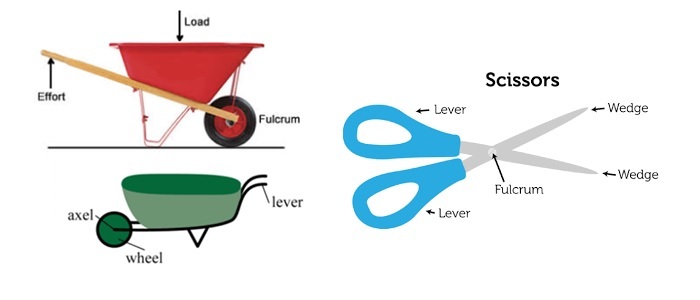
There is a huge variety of compound machines available to assist with a large number of tasks. Several examples of compound machines include: bicycles, pliers, wheelbarrows and scissors.
- In bicycles, the pedals and wheels form cooperating wheel and axle systems, the brakes are levers and the parts are held together with multiple screws. Pliers are constructed with multiple levers.
- A wheelbarrow is a combination of a lever and wheel and axle.
- Scissors consist of two pivoting levers.
Source: sciencing