Understand basic economic concepts such as scarcity, supply and demand, costs and benefits, etc.
What is Economics
Economic agents / society have some economic problems because of the scarcity of resources. They need to choose scarce resources among alternatives (scarce resources) based on choice and valuation of alternatives.
Thus economics is the study of how economic agents or societies choose to use scarce productive resources that have alternative uses to satisfy wants (needs) which are unlimited and of varying degree of importance.
Review of Economic Terms
- Resources – are factors of production or inputs. – Examples: Land Labour • Capital • Entrepreneurship
- Scarcity – is the condition in which resources are not available to satisfy all the needs and wants of a specified group of people. Example: Most underdeveloped nations have natural resources, but do not have capital or skilled labour to develop them.
Because of scarcity, an allocation decision must be made. The allocation decision is comprised of three separate choices:
- What and how many goods and services should be produced?
- How should these goods and services be produced?
- For whom should these goods and services be produced?
Core Principles of Economics
How people make decisions
- People face trade-off
- The cost of something is what you give up to get it
- Rational people think at the margins
- People respond to incentives
How people interact
- Trade can make everyone better-off
- Markets are usually a good way to organize economic activity
- Governments can sometimes improve market outcomes
How the economy as a whole works
- A country’s standard of living depends on its ability to produce goods and services
- Prices rise when the government prints too much money
- Society faces a short–run trade off between inflation and unemployment
Value
Value refers to the power that goods and services hold so that they can be exchanged for other goods and services (value-in-exchange). For example, if one cycle can be exchanged for two cycles, then the value of one cycle is equal to two cycles.
A commodity can possess value only if it has the following characteristics.
- Utility: It needs to have utility. A rotten or broken egg has no utility because no one would want it and it cannot be exchanged for anything (possesses no value-in-exchange).
- Scarcity: Free things like air does not have value. So besides utility, a product /service has to be scarce.
- Transferability: It should be transferable from one place to another or from one person to another.
Supply and Demand
Supply and demand is a basic concept of economics. Demand refers to how much (quantity) of a product or service is desired by buyers. The quantity demanded is the amount of a product people are willing to buy at a certain price; the relationship between price and quantity demanded is known as the demand relationship.
Supply represents how much the market can offer. The quantity supplied refers to the amount of a certain good producers are willing to supply when receiving a certain price. The correlation between price and how much of a good or service is supplied to the market is known as the supply relationship. Price, therefore, is a reflection of supply and demand.
Most markets are driven by supply and demand. The concept of supply and demand also helps us understand why popular products become cheaper over time.to explain why last year’s popular product is half the price the following year.
For example, taking the example of breakfast cereals, if a lot of people want to buy breakfast-cereals, you can assume that the demand for breakfast cereals is high. As a result, companies can charge more for their cereals and they can divert some of the raw materials (such as dry fruits) to make cereals instead of something else (say sweets).
On the other hand, the increased demand could also attract more manufacturers in the market, which could eventually lead to an oversupply of cereals in the market, because of which the prices of cereals will start falling.
Although this is a simplified example, it gives you a basic idea of the concept of supply and demand.
Costs and Benefits
The concept of costs and benefits is applicable to most decisions that we all make, and it applies to non-financial transactions as well.
Here are a couple of examples:
If demand bottled water is high, bottling companies will hire more people and make more bottled water, but only if the price and quantity they are selling justify the additional costs they need to incur to make more bottles of water.
Similarly, the consumer will buy the best bottled-water can afford to purchase, and not necessarily the cheapest or the most expensive.
We apply this concept in our daily lives as well, which making decisions.
While economics assumes that people are rational most of the time, humans actually make emotional decisions most of the time that do not maximize their own benefit. Advertising tries to capitalize on this tendency of humans to act non-rationally. Most commercials (ads) that we see try to activate us emotionally and we end up overestimating the benefits of the product that is being promoted.
Elasticity of Demand in Economics
Elastic goods and services generally have lots of substitutes. As a result, if an elastic service/good’s price increases, the quantity demanded of that good decreases. Example of elastic goods and services include furniture, motor vehicles, instrument engineering products, professional services, and transportation services.
Different types of elasticity of demand:
Perfectly Elastic Demand (EP = ∞)
Perfectly Inelastic Demand (EP = 0)
Relatively Elastic Demand (EP> 1)
Relatively Inelastic Demand (Ep< 1 ) Unitary Elastic Demand ( Ep = 1) MBA case study / assignment question on this topic: “There is a high cross elasticity of demand between new and old cars”. Discuss the statement by explaining the features of cross elasticity of demand. Also compare and contrast cross elasticity with other types of elasticities of demand.
Competition in Economics
In economics, “competition” means the rivalry among sellers in the market who are trying to increase their profits, market share, and sales volume by offering the right marketing mix: price, product, promotion and place.
The four types of competition in a free market system: perfect competition, monopolistic competition, oligopoly, and monopoly.
WTO and RTAs
World Trade Organization (WTO) is a global institution that helps create rules for global trade, with the help of its member nations.
A regional trade agreement (RTA) is a treaty between the governments two or more countries; it lays down the rules of trade for all signatories. RTAs are defined as reciprocal trade agreements amongst two or more partners, including free trade agreements and custom unions.
Few Examples of regional trade agreements include the North American Free Trade Agreement (NAFTA), Central American-Dominican Republic Free Trade Agreement (CAFTA-DR), the European Union (EU) and Asia-Pacific Economic Cooperation (APEC).
Regional trade agreements, in general, are of the following types: Custom Union, Free Trade Agreement, Common Market, Economic Union, Preferential Trade Agreement.
Here are some RTAs and their member countries.
North American Free Trade Area (NAFTA): US, Canada & Mexico
Andean Community: Bolivia, Chile, Ecuador, Colombia, Peru
Common Market of the South (MERCOSUR): Brazil, Argentina, Paraguay and Uruguay
European Union: 28 European countries in July 2013
South Asian Free Trade Area: India, Pakistan, Sri Lanka, Bangladesh, Nepal, Maldives & Bhutan
Economic Community of West African States (ECOWAS): 15 West African countries including Nigeria
Useful Link: RTAs on WTO.org
Macroeconomics
Macroeconomics is the study of the total or aggregate level of output, income, employment, consumption, investment and prices for the economy viewed as a whole.
Macroeconomics is a branch of economics that studies how the economy behaves as a whole, in totality. As compared to microeconomics which is concerned with individual economic units such as a family, a firm or an industry,
Macroeconomics is concerned with the while economic system, such as National income. Various other factors such as national income, total savings and investment, total demand and supply, inflation, general price levels, rate of growth, gross domestic product (GDP), total unemployment are studied.
Microeconomics
Microeconomics is the study of the economic behaviour of individuals decision-making units such as individual consumers, resources owners and business firm in the free enterprise system.
Microeconomics is a branch of economics that studies a smaller area of economics, including the implications of individual human action and firms on the utilization and allocation of scarce resources. Microeconomics shows conditions under which free markets lead to desirable allocations, and why different goods have different values. Microeconomics does not attempt to explain what should happen in a market, it only explains what to expect if certain conditions change.
The study of microeconomics involves several key concepts, including: Demand, supply and equilibrium; Production theory (converting inputs into outputs); Costs of production and Labour economics.
Revenue Types
Revenue refers to the income earned by a firm through the sale of goods at different prices.
In the words of Dooley, ‘the revenue of a firm is its sales, receipts or income’. The revenue concepts are concerned with Total Revenue, Average Revenue and Marginal Revenue.
‘Marginal Rate of Substitution’
The marginal rate of substitution (MRS) is the amount of a good that a consumer is willing to give up for another good, as long as the new good is equally satisfying. It’s used in indifference theory to analyze consumer behavior.
The marginal rate of substitution is calculated between two goods placed on an indifference curve, displaying a frontier of equal utility for each combination of “good A” and “good B.”
The marginal rate of substitution is the rate of exchange between some units of goods X and Y which are equally preferred. The marginal rate of substitution of X for Y – MRS(xy) is the amount of Y that will be given up for obtaining each additional unit of X.
Marginal rate of substitution MRS(x,y) = the marginal rate of substitution between both goods.
MRS(x,y) = dx/dy
dx = the change in good x, the number of units a consumer is willing to give up
dy = the change in good y, the number of units a consumer gains by giving up units of good x
Isoquants and Indifference Curves
An isoquant is similar to an indifference curve in several ways. In it, two factors (capital and labour) replace two commodities of consumption. An isoquant shows equal level of product while an indifference curve shows equal level of satisfaction at all points.
However, there are certain differences between isoquants and indifference curves.
- Firstly, an indifference curve represents satisfaction which cannot be measured in physical units. In the case of an isoquant the product can be measured in physical units.
- Secondly, on an indifference map one can only say that a higher indifference curve gives more satisfaction than a lower one, but it cannot be said how much more or less satisfaction is being derived from one indifference curve as compared to the other, whereas one can easily tell by how much output is greater on a higher isoquant in comparison with a lower isoquant.
Law of Variable Proportions
The law of variable proportions states that as the quantity of one factor is increased, keeping the other factors fixed, the marginal product of that factor will eventually decline.
This means that up to the use of a certain amount of variable factor, marginal product of the factor may increase and after a certain stage it starts diminishing. When the variable factor becomes relatively abundant, the marginal product may become negative. Law of Variable Proportions is also known as Law of Proportionality.
Demand Forecasting in Economics
Managers often resort to tools that will help them predict the future to some extent. Business forecasting is an essential component of corporate planning as it enables the organization to minimize risk and uncertainty. Demand forecasting is a specific type of business forecasting.
Demand forecasting helps organizations reduce risks involved in business activities and make important business decisions. It also provides an insight into the organization’s capital investment and expansion decisions.
Demand forecasting is not a speculative exercise into the unknown. It is essentially a reasonable judgement of future probabilities of the market events based on scientific background. Explain the statement by elaborating different qualitative and quantitative methods of demand forecasting. Which of the methods described by you is most suitable for forecasting the demand for “expensive mobile” and why?
Opportunity Cost
Opportunity cost is the value of the most valuable of all the options that one has to forego while choosing from a set of options.
In Managerial Economics, the opportunity cost is a useful concept as it helps in making decisions, especially when the manager has to make choice between different alternatives. Most business activities are carried on within constraint (‘scarcities’) which force choices and consequent sacrifices to be made.
In the corporate environment, managers often have to take decisions where they might have to forego the production of one commodity to fund the production of another commodity, or forego few projects to fund some other project.
And it applies in real life as well; almost every person and household applies the concept of opportunity cost in real life. Opportunity cost is the value of the most valuable of all the options that one has to forego while choosing from a set of options.
This is the basic concept of opportunity cost and it arises only because some essential input, money or capacity, is scarce and insufficient to take up all the options that are desirable.
Opportunity Costs are important when considering make-or-buy decisions, and also when deciding whether or not to sell something. Opportunity cost is also used to analyse capital projects. The discount rate used to find out net present values when evaluating capital projects is nothing but an opportunity cost of capital.
Here are a few more examples of opportunity cost that usually arise in business environment.
- The opportunity cost of using a machine is the most profitable alternative sacrificed by employing the machine in its present use.
- The opportunity cost of working for oneself (applies to most entrepreneurs) is the salary that one could earn in others occupations.
- The opportunity cost of funds used in one’s own business is the interest that could be earned on those funds by investing it elsewhere.
- The opportunity cost of buying a color TV for the reception area is the interest or profit that could be earned by investing the purchase money.
So opportunity cost requires the measurement of sacrifices, be it real or monetary. However, some decisions require no sacrifices to be made and is cost free.
In the above example, if the machine was lying idle, then the opportunity cost of using that machine for production is zero. If there were no constraint of money or capacity, there would be no need to sacrifice and hence no opportunity cost would arise. Also, opportunity cost is just a notional idea which does not appear in the books of account of the company.
This is the basic concept of opportunity cost; it arises only when some essential input such as money or capacity is scarce and insufficient which prevents us from taking up all the desirable options. If there were no constraint of money or capacity, there would be no need to sacrifice and hence no opportunity cost would arise.
Example
Every family has limited income and access to resources. Each member in the family may have a long list of shopping items that he or she may want to buy, but not everybody has the budget to buy all the things. That is where people are forced to make a choice; one has to forego few things in order to buy other things.
For example, a family may like to spend a Sunday by having breakfast at a restaurant, followed by a trip to a place like Kidzania, followed by lunch at Barbeque Nation, followed by a movie at the theatres. However, for a family of four, this itinerary could mean spending up to 10 thousand rupees in a day. So the family may be forced to reconsider the various options. Maybe they would now have breakfast at home and leave; they could replace Kidzania with a visit to the zoo or to the beach; they could replace Barbeque Nation with some other inexpensive restaurant.
Here’s another example. Say a carpenter gets work to make furniture in family A. After analysing the requirements and time required, he gives a quote of Rs. 25,000 for the work. Suppose, in the meantime, two other families B and C, reach to him to do their work. These two families are ready to give him work worth Rs. 15,000 and Rs. 20,000, respectively.
However, they all need the work to be done in the same week and the carpenter doesn’t have the bandwidth to accept multiple work. In that case, he would accept the work of Family A, the most profitable one, and let go of the other two. His opportunity cost in this case would be Rs. 20,000, the sacrifice of the next best option. Had he chosen either family B or C, his opportunity cost would have been Rs. 25,000 profit that he would have earned from family A.
We once went to a mall for shopping; when browsing through the various shops, we reached a computer store and a friend of mine said that she wanted to order a printer for home use. She was trying to decide between two printers, one of which cost Rs.25000 and had more features as compared to a second printer that cost Rs. 18000. After spending a lot of time thinking about what to choose, the salesman present at the store asked her whether he would rather have the printer with more features or opt for the cheaper printer and have Rs. 7000 worth of cartridges for the printer. Immediately, she selected the cheaper printer along with those extra cartridges.
In this case, the money that was not spent on the printer was made available for other purchases, in this case cartridges that would come in handy once the printer got into use at home. While paying for the printer at the checkout, we bumped into the owner of the store who happened to be someone whom I knew. I told him that he had a nice store. But he told me that while the place was good, the rent in the mall was too high. Offices located few blocks away from the mall were available for 30% less rentals, without much change in footfalls. He felt he could have spent that extra money in his business for buying more goods or for hiring extra staff.
That is when I realised that we often find ourselves in situations where we have to make choices. In some cases, the choice is between buying an item (say a purse) and not purchasing it. In other cases, the choice is between a more expensive option and a less expensive option.
It also occurred to me that people generally don’t usually think about opportunity costs when making choices, unless they are reminded of it by another person.
I personally observed that when I was shopping with my friends in the other stores in the mall; I saw was that my friends bought the cheaper option (or did not purchase at all) when they were reminded of the opportunity cost of making the purchase.
Management (MBA) questions, study/assignments on Demand forecasting .
Question. Demand forecasting is not a speculative exercise into the unknown. It is essentially a reasonable judgement of future probabilities of the market events based on scientific background. Explain the statement by elaborating different qualitative and quantitative methods of demand forecasting.
Q. What is Demand forecasting? Explain different qualitative methods of demand forecasting. State which of the methods described is most suitable for forecasting the demand for “newspaper” and why?
Q. Kiara Enterprises is a very small organisation dealing with export rejected clothing. They are growing slowly but steadily. Kiara, the owner now wants to expand it a bit more and hence opts for Human Resource planning. It is advised to them to go for qualitative methods for demand forecasting as they have limited funds. Discuss all three qualitative methods of demand forecasting. Conclude by suggesting the best method suited for Kiara’s organisation.
Question. Complete the hypothetical table below and explain in brief, the law of variable proportions.
Quantity, Total Product, Average Product, Marginal product
1, 10
2, 30
3, 48
4, 56
5, 56
6, 52
Question on Marginal Rate of Substitution. The manager of a company was analysing the trend of the products of its company (Commodity Y) getting replaced by another substitute product available in the market which gives the same level of satisfaction to the consumers. Calculate the rate of Marginal Rate of Substitution and analyse the result.
Combination, Units of Commodity Y, Units of Commodity X, Total Utility
a, 40, 10, U
b, 25, 14, U
c, 17, 19, U
d, 10, 27, U
e, 7, 38, U
Question: Explain how the consumer attains utility maximisation and producer ensures cost minimization with the help of indifference curve and isoquant technique.
Question on Microeconomics: Select 1 or 2 key theoretical concepts. with a strong microeconomic focus. from what has been discussed in class and provide a critical overview of its value in explaining or solving one or more real world microeconomic challenges (some general thematic suggestions include: “impact of smoking ban on pub closures in the UK’;”monopoly power and monopoly pricing amongst pharmaceutical companies’; ‘priclng policies amongst budget and other airlines’; etc,). Your work should be presented in essay format but may include tables. diagrams, etc, and may need a bibliography, dependirg on what you choose to work on. All bibliography entries need to conform to the Harvard referencing style.
Question. From the give table calculate Elasticity of Price, Total Revenue and Marginal Revenue. Also, explain the relationship between AR and MR.
Q. Explain the concept of opportunity cost arising from the central economic problem of Scare resources and unlimited wants.
a) What is the opportunity cost of seeing a movie?b) Who will incur a higher opportunity cost if they were to cut their own lawn, you or the billionaire Bill gates? Explain?
Q. Use the graph to answer the following questions:
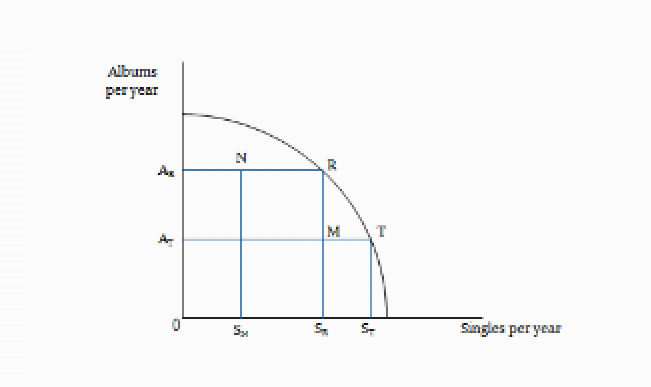
b) In moving from R to T, what is the opportunity cost to the studio in terms of albums forgone? Explain what is happening.
c) If the studio starts at point N and moves to R, what is the opportunity cost in terms of albums forgone? Explain what is happening.
d) Suppose the studio starts at point M, what possibilities are available to expand production?
Q. Coca Cola and Pepsi are the world’s two largest producer of soft drinks. Profitability of both companies depends on sales volumes, cost of sweeteners and other inputs. Coca Cola decides to increase its retail price by 7%. Price increases were welcomed by the owners with the justification of improving overall profitability and margin.
a) Should Pepsi follow the 7% price rise by Coca Cola?b) How would the price increase affect level of sales for Coca Cola?
c) How advertising expenditure should be related to pricing?
d) How are Coca Cola and Pepsi affected by changes in the price of their inputs?
Q. What are the three basic economic problems? How are these problems related to allocation decision and types of economies?
Q. Describe the difference between the accounting and the economic concept of profit. How are they useful for managerial decision making?
Q. Explain the differences between profit maximization and shareholder wealth maximization. Which assumption provides a better model of a firm’s behaviour?
Q. Explain the implications of the agency problem for the theory of the firm.
Q. Task One – Questions on Economics – Important Concepts
TASK Two – Write an ESSAY
Task 2a
The management of Ace Body Gyms has asked you to evaluate the effects of the predicted changes in the UK economy outlined above on the performance of the company. Specifically, you should write an essay to address the effects of the independent report on the performance of Ace Body gyms. Performance should include, but is not limited to, the effects on price, cost, demand, investment opportunities, profits etc.
Task 2b
Your report should also include recommendations as to how Ace Body Gyms could maintain a solid performance despite the predicted economic downturn.Harvard referencing
Marks are also awarded for the structure and presentation of material, including the use of the Harvard Citation and Referencing system.
NOTE: your essay must include at least 5 academic (e.g. referred journal articles or text books) references.
For Part A
- Look at the predicted changes in the UK economy in the paragraph above.
- What effect will each of them individually have on the performance of Ace Body gyms? Think about what we mean by “performance”.
- What effect will they have overall?
Then work out the effect of each on:
Price, Cost, Demand, Investment opportunities, Profits, Other measures of performance?
(You may wish to cover them in a different order.)
You will need to consult your notes for each relevant week, to work out what could happen.
For instance, economic growth…will slow and… result in high unemployment. Which factor of performance will this affect first? What will happen? Will it then affect other factors? How? In what way?
You may cover the effects of each predicted change individually for each part of the performance, as above, or in an overall context.
For instance, economic growth will slow, resulting in high unemployment and lower investment, whilst higher oil prices will lead to inflation. This will affect Ace Body gyms by… affecting price by…affecting cost by…etc.
For Part b
The last sentence of the paragraph gives additional information about how the company may tackle some of the issues.
“The report has urged the UK government to engage more with non-European markets which it says will result in more trade, more foreign investment and more knowledge transfer and sustained economic growth.”
Look through your notes for each relevant topic in the paragraph and each performance factor. For each performance factor, find out how it could be improved, minimised or maximised as appropriate. For instance, what would the business want to do with its costs? Which theory or concept can you link to? Can you link it to the information in the last sentence in the paragraph?
For higher marks, make sure you link what you are saying to an appropriate theory or concept. For instance, with pricing, which pricing strategy would you use to maximise the performance of the business?
And finally…
Finish with a conclusion, summarising your response in parts a and b. Remember to include at least five academic references.
Question. The government of India has asked all the manufactures and importers of pulse oximeters and oxygen concentrators to provide price-related data. The idea being to check the price movements of this equipment and ensure that their existing price are not increased more than 10% in a year. These efforts have been taken to check the timely availability of critical medical equipment at an affordable price to consumers. National Pharmaceutical Pricing Authority (NPPA) is the authority that regulates prices of critical drugs and medical equipment as per the provisions of Drug Price Control Order (DPCO) and puts a cap on their prices, if necessary. In the prevailing situation, for the larger interest of the public, NPPA has imposed on the medical devices industry associations to bring down the retail price of these critical medical equipment.
With a similar objective to serve public interest best, the Government of India (GOI), from time to time, amongst other policy measures, has also undertaken initiatives to increase minimum wage rate to support unskilled and unorganized workers to facilitate their standard of living. In the light of above background, analyse a few of the price control initiatives undertaken by the government; linking it to the concepts/topics discussed under the Introduction to Economics course. lease follow APA guidelines.
Question: Margo spends $10,000 on one year’s college tuition. What is the opportunity cost of spending one year in college for Margo? Thus, what is the cost of going to college?
Question: Marla will make $10 by tutoring for an additional hour but she will lose an hour of studying for her own economics test. Marla decides to study rather than tutor. What does Marla’s choice indicate about the value of an additional hour of studying?
Question: Which of the following are macroeconomic issues, which are microeconomic issues, and which could be either depending on the context?
- a. Inflation.
- b. Low wages in certain service industries.
- c. The rate of exchange between the AUD and USD.
- d. Why the price of cabbages fluctuates more than that of cars.
- e. The rate of economic growth this year compared with last year.
- f. The decline of traditional manufacturing industries.
Question: Consider the issue of Nike setting up factories in Bangladesh, a result of globalisation. Who are the winners and who are the losers? Is wellbeing for the people in Bangladesh improved?
Question: Questions 6 and 7 from Frank and Benanke, p. 437.
Question: Questions 6 and 7 from Goodwin et al., p. 147.
Question: Consider the attached extract of an article. What is likely to happen to the GPI due to this event?
Questions on Macroeconomics
Q. Choose one key practical macroeconomic concept from what this class intends to cover and provide a critical overview of its value in explaining, or solving, one or more real world macroeconomic problems or challenges. Examples of topics that may be used appear below.
Your work has to be in essay format but may benefit from inclusion of tables, diagrams, etc., and most probably will need a bibliography, depending on what you choose to work on. If a bibliography is required please be sure to present this in Harvard style (here is an example: http://libweb.anglia.ac.uk/referencing/harvard.htm)
Examples of topics/areas to focus on:
- How would you explain the stability seen in UK interest rates over the past 8-10 years and how are they likely to change in the UK in the event of a ‘no-deal Brexit’?
- Offering examples as well, explain why central bank independence is important.
- In recent months UK unemployment date has looked very healthy. How would you explain this outcome?
- Would we be correct in describing President Trump’s internal economic policies as Keynesian?
- In mid-July this year (2019) the Office for Budget Responsibility (O8R) released a report suggesting that a no-deal Brexit would further reduce prospects for economic growth and add to national borrowing figures. Explain what you believe to be the main assumptions underpinning these predictions.
What do you need to read to prepare for this task? Other than the assigned textbook, please do remain aware of current and recent macroeconomic news via resources such as the BBC, CNN, SKY News, quality newspapers, such as the FT, etc. Please do consider signing up for news-rich Twitter feeds from the ONS and others.
Q. Using straightforward economic analysis (demand, supply, scarcity of resources, etc.) explain why an economy engaged with international trade is likely to develop and grow more than one that avoids international trade. (1750 words)
Choose 1 key theoretical concept, with a strong macroeconomics focus, from what has been discussed in class and provide a critical overview of its value in explaining, or solving, one or more real world macroeconomic problems or challenges. Examples of topics that may be used are mentioned below. Your work should be presented in essay format but may benefit from inclusion of tables, diagrams, etc., and may need a bibliography, depending on what you choose to work on.
Examples of topics! areas to focus on:
1. Given the difficulty in fitting the PPF framework to an actual real economy, explain why economists still use it as part of their explanations of how economies allocate resources}
Z. The UK economy was caught in the grips of a rampant speculative property market for much of the 1980s and again in the early part of the 2000s. Provide an assessment of how speculative asset bubbles influence consumer
spending decisions.
3. Using straightforward economic analysis (demand, supply, scarcity of resources, etc) explain why an economy engaged with international trade is likely to develop and grow more than one that avoids international trade.
Other than the assigned textbook, please do remain aware of current and recent macroeconomic news via resources
such as the leading news channels and newspapers, etc.
Question: Is it true to believe that the importance of fiscal policy as a tool in stabilizing the economy is declining and that of monetary policy is rising because the recent debt problem had to do more with financial aspects? Justify your statement with practical support with regard to PIIGS economies.
Question: How far do you think that 51% FDI in multi brand retail decision in India is taken because of foreign pressure? If no then why there is so much of confrontation of views amongst the experts and if yes then why has this situation of foreign pressure taken place? Why do you think that single brand retail has not picked up in spite of allowing 100% FDI in India? Explain.
Question: Why Hecksher-Ohlin theory of International Trade was developed when we already had Adam Smith’s and David Ricardo’s theory? Explain. What role do you think currency fluctuations play in international trade? Explain with reference to fixed, managed and freely floating exchange rate regime. Analyze.
Question: Double counting makes our National Income much bigger than actual whereas if we talk of prevalence of non monetized sector in our economy then our National Income figure becomes smaller than actual. Which method you think is best and why? What is your view regarding HDI? Explain.
Questions on Demand and Supply
Q. What does a demand curve show?
Q. What does a supply curve show?
Q. Produce a diagram: for the market for air travel that shows the effect of a news report on the dangers of travelling by sea.
Q How does Pepsi advertising affects the demand for: a) Pepsi b) Coca-Cola
Q. Explain how changes in consumer income affect the demand for Apple’s I-phone
Q. Use the table below to answer the following questions
What is the equilibrium price and quantity?
What would be the size of the shortage or surplus at a price of €180/tonne?
Assuming the demand for organic wheat rises by 180 tonnes per week at all prices, what would be the new equilibrium price and quantity?
Q. The beer industry is being revolutionized with the invention of new machinery which makes it cheaper and quicker to produce. Identify what would happen to equilibrium price and quantity in the market for beer.
Q. Analyse the specific factors that would affect the demand for McDonalds.
Q. Analyse the effects of the following on equilibrium demand and supply for cars, clearly identifying the shift in the curve:
a) A higher tax on gasoline
b) Increase in wages
c) Reduction in the cost of production
d) A tax on car parking
e) Increased provision of reliable cheap public transport
f) Government legislation for increase safety in cars, like side impact protection
g) Increase in the price of cars
h) Increased in the disposable income of consumers and Improvement in technology used in car manufacturing
Q. The demand for corn is linear and when the price of corn is $800, zero units of the good are demanded. When the price of corn is $0, then 800 units of corn are demanded. The supply of corn is linear and when the price of corn is $100, zero units of the good are supplied. When the price of corn is $1000, then 900 units of corn are supplied.
a) Given the above information, what is the equilibrium quantity and equilibrium price in this market?
b) Suppose a price ceiling of $500 per unit is imposed in this market by the government of Urbana. This will result in…
c) Suppose a price ceiling of $400 per unit is imposed in this market by the government of Urbana. This will result in…
Q. An example of a price control is a law that sets a minimum price that may be legally charged for an agricultural product, such as milk.
a) Is this farm price control a price ceiling or a price floor?
b) Draw a supply and demand diagram to illustrate the market price, equilibrium price, quantity supplied, quantity demanded, and the surplus or shortage when there is a binding farm price support.
c) What is the social objective of a farm price support? Is it effective?
Q. True-False Questions — If a statement is false, explain why.
a) The law of demand states that as price decreases, quantity demanded decreases. (T/F)
b) The market demand for a good is the sum of individual demands for the good. (T/F)
c) An increase in the number of suppliers in a market will cause the supply curve to shift to the left. (T/F)
d) An increase in the price of a good will cause the supply curve to shift to the right. (T/F)
e) An increase in supply causes an excess demand at the original price, and competition between sellers leads to a lower equilibrium price. (T/F)
f) An increase in demand causes an excess demand at the original price, and competition between demanders leads to a higher equilibrium price. (T/F)
g) The expectation that the price of a good will increase can cause the demand for that good to increase. (T/F)
h) If two goods are complements, then one can replace the other in consumption.. (T/F)
i) If income increases and the demand for a good increases, then it is a normal good. (T/F)
j) A change in demand refers to a movement along a demand curve due to a price change, but a change in quantity demanded refers to a shift in the entire demand curve. (T/F)
Q) Neha has just completed her MBA and joined a startup company. The company was planning to launch a new product in the market so the management wanted to understand the different factors that can impact the demand and supply of their products in the market. Help Neha to prepare a report on the factors impacting demand and supply of products in the market.
Q) Alpha Ltd market share was declining due to high competition in the market so it decided to enter a new segment. It wanted to determine the relationship between change in the quantity demanded of the product due to change in the price of the product in the market. Assume that at the price of ₹100, the demand for the product is 400 units. If the price of the product increases to ₹120, the demand decreases to 250 units. Calculate the price elasticity:
a) Using Arc elasticity method
b) Using Percentage method
Q)
a) What are the practical uses of the concept of price elasticity of demand for
different stakeholders in the production process?
b) Distinguish between the shift and movement in the demand curve.
Explain any five factors which would bring about a shift in the demand
curve for Maggie noodles.
Q. Explain the types of elasticity of demand. Calculate elasticity of demand for the following data.
Price of Apple (Rs.) Quantity demanded (KGs)
20, 100
21, 96
Q. Distinguish between the features of perfect competition and monopolistic competition. Give real world examples of each of these types of markets.
Questions on competition:
Q) Which market is characterized by the “competition among few”? how is this market different from the “competition among many”? Explain how the producers in this kind of market promote their own interests by giving real world examples like OPEC, Cement Cartels, etc.
Q) “In the monopolistic competition, a few firms sell differentiated products” Explain
this statement by highlighting important features of this kind of a market.
Substantiate your answer by a live example. Also explain how the equilibrium in
this kind of a market is different from a long run equilibrium under perfect
competition.
Question: The most favoured nation principle has been the basis of the WTO agreements. Has trade non-discrimination proven to be a good design for multinational businesses.
Answer: Read here
Question: What trade risks does a multinational company face? Can these risks be fully mitigated? Explain your answer using examples and relevant theory.
Question: Critically evaluate the role the World Trade Organisation (WTO) plays in world trade and international business. Explain with examples to illustrate your answer, any three benefits of the WTO to businesses.
Q. Select any trade dispute between two countries from this webpage on the WTO site: https://www.wto.org/english/tratop_e/dispu_e/dispu_by_country_e.htm select the ‘dispute by complainant tab’.
Summarise the main arguments from each side and explain where the dispute is in the WTO complaint process.
What do you think the equitable outcome should be? Why? Present your answers.
Present your ideas in a world cafe organisation. Each group representative stays on table, everyone else goes to different table. You will be given time to go back to your groups and discuss what other teams discovered. Save your work to Microsoft teams.
Discussion:
- What patterns can you notice from the complainers?
- What patterns can you notice from the winners?
- Why do countries from the Global North tend to complain more than those from the South?

Leave a Reply