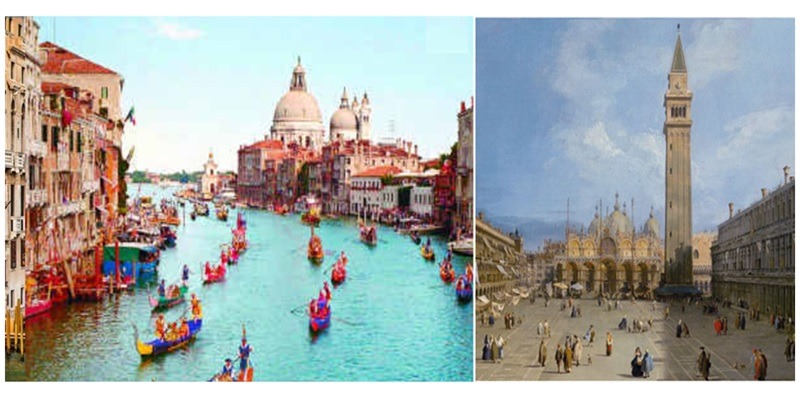
The Merchant of Venice is a 16th-century play written by William Shakespeare. The famous Shakespearean play features several endearing and well-loved characters. Let’s take a look at the story.
Merchant of Venice – Summary
Antonio and Bassanio are very close friends. Bassanio needs money to court the wealthy Portia, so he approaches Antonio, who is a merchant. Antonio doesn’t have enough cash in hand so he asks Bassanio to borrow money from a lender based on the security of Antonio’s expected shipments; Antonio is willing to get into a loan contract with the lender.
Bassanio approaches Shylock, a Jewish moneylender, for the loan. Shylock however holds a grudge against Antonio for his lending practices and apparent antisemitism (discrimination towards Jews). But he still offers the loan provided he can extract a pound of Antonio’s flesh if the loan isn’t repaid on time. Bassanio is reluctant with the terms but Antonio is very confident about his expected shipments. Bassanio eventually take a loan from Shylock who ensures the contract mentions that he can extract a pound of flesh from Antonio if he fails to honour the contract.
Shylock’s daughter, Jessica, wants to marry Antonio’s friend Lorenzo and is ready to become a Christian. Jessica elopes, taking gold and jewels with her. Shylock develops hatred for Christians.
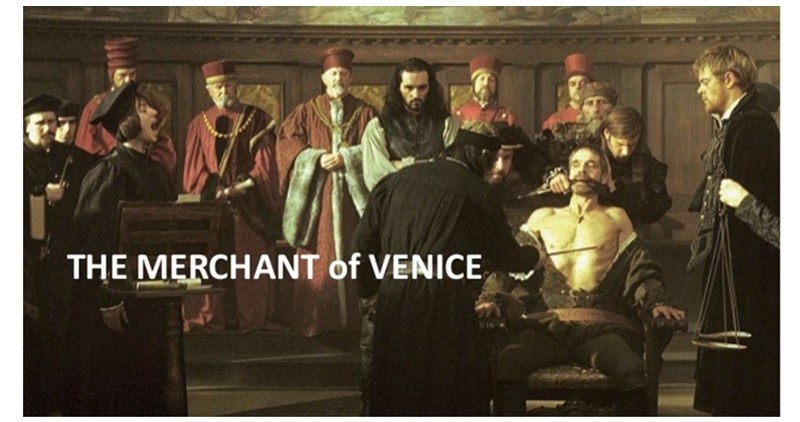
Antonio’s ships are lost at sea, he is now bankrupt and is unable to repay the loan. Shylock is adamant on taking a pound of his flesh and drags Antonio to court. Portia, now the wife of Bassanio, and Nerissa (Portia’s maid) go to the court disguised as lawyers and manage to save Antonio. Portia asks Shylock to have mercy on Antonio, Bassanio offers him twice the loan amount, but Shylock refuses to accept. Finally, Portia explains to the Duke, presiding over the court, that the bond is only for flesh and not for blood. So Shylock can collect the flesh only if no blood is spilled and the amount extracted has to be exact.
This argument saves Antonio. For threatening the life of a Venetian, Shylock is made to to forfeit his goods.
Merchant of Venice – Language
The language used today is, in many ways, different to that used in the 16th-century Elizabethan era and you can clearly see in the script and text used in Shakespearean plays.
In several scenes, you will come across words/phrases in the text/script of Merchant of Venice that may not be easy to understand. There are several free online Shakespeare Dictionary where you can check the meaning of the obscure words used in the script and text of his plays, some of which are no longer in use in modern language or Dictionaries. Just note down the unusual words or text that you encounter whilst reading the online text of the play and look for its definition/meaning in the free online Shakespeare Dictionary.
Because William Shakespeare never published any of his plays, none of the original manuscripts have survived. However, several unauthorised versions of his plays were published during his lifetime in quarto editions by unscrupulous publishers (copyright laws did not exist back then which could protect Shakespeare and his works during the Elizabethan era). A collection of his works did not appear until 1623 (seven years after Shakespeare’s death on April 23, 1616) when two of his fellow actors, John Hemminges and Henry Condell, posthumously recorded his work and published 36 of William’s plays in the First Folio.
Useful Links:
Academic Questions on The Merchant of Venice
Q. ICSE PROJECT 1 (Drama)
TOPIC: William Shakespeare with his genius and originality has unified and organized the two subplots, the Bond story and the Casket story, to make a single organic whole. Justify the given statement with close reference to the play, The Merchant of Venice. Through this project, the students will be able to appreciate the emotion reflected in the play, and understand its factual, inferential and evaluative.
Answer:
The two events (Bond story and the Casket story) are related as Bassanio is the common character in both the subplots. Antonio agrees to sign a bond with Shylock to financially help his friend Bassanio, who needed the money to court the wealthy Portia.
Question: Show the interdependence of the bond story and the casket story in ‘The merchant of Venice.”
Q. SUGGESTED ASSIGNMENTS Assignments should be based on the prescribed textbooks on the following lines: (i) Character/thematic analysis; (ii) Socio-economic, cultural, historical relevance / background; (iii) Summary / paraphrase. (iv) Appreciation of literary qualities. (v) Identifying with a character. Putting oneself in the place of a character in given circumstances and explaining one’s actions. (vi)Imagine alternative outcomes or endings in a literary piece and the effect on all concerned.
Question: What does one understand about the friendships and bonding among the main male characters of the drama from the 1st and 2nd Acts of the play? Substantiate your answer with suitable examples.
Question: What is the significance —both structurally and thematically—of the ring episode in the Trial and later scenes of the drama?
Question: Shylock’s speech, beginning, “Hath not a Jew eyes…?” is often called “Shylock’s Defense. ”Write a speech from the perspective that Shylock is a villain; the other, from the perspective that Shylock is a victim. Find textual examples to support your claim.
Also Read:
Q. The famous eighteenth-century writer Samuel Johnson refers to the “improbability” of The Merchant of Venice in one of his essays. What qualities of the play are the most improbable? Despite these improbabilities, what makes the play relatable even to modern-day readers? Discuss its universal or timeless elements.
Q. Justify the statement that The Merchant of Venice is a plea for religious tolerance. In what light do you see Shylock’s character? How would you defend him against the hostility of the Christians if you were to represent him in the Venetian court of law?
Q. Although some critics argue that from an Elizabethan perspective, forced conversion represents genuine mercy, the moment seems intended to shock. Express your views on Shylock’s forced conversion at the end of the trial scene. What impact do you think this will have on his place in Venetian society?
Q. The conflict between Shylock, the Jewish Moneylender and Antonio, the Christian Merchant is both religious and economic. Dwell on their enmity and explore the ways in which Shakespeare portrays the two characters to show their differences and similarities.
Q. Throughout the play, Christians de-personalize and alienate Shylock by refusing to use his given name. Instead, they call him “the Jew,” “the villain Jew,” “this currish Jew,” “impenetrable cur,” “harsh Jew,” “cruel devil,” and the devil “in the likeness of the Jew.” To the Christian characters, Shylock is the embodiment of the devil. Is Shylock a villain or a victim? Use evidence from the play to support your response.
Q. Write in modern English ten reasons why Shylock hates Antonio. Justify it with the corresponding quote from the text
Q. Bring out the theme of appearance and reality in the play ‘The Merchant of Venice.’
Q. Which character do you relate with the most in the play, ‘The Merchant of Venice’? Write the good and bad qualities of that character. Also write about a similar person you have come across in real life. Which quality or qualities of this character/person would you like to adopt?
Question: Portia’s portrayal is an embodiment of feminism in the sixteenth century in Venice. Elucidate the above statement with close reference to Shakespeare’s play, ‘The Merchant of Venice. Substantiate your writing with illustrations from the drama.

Leave a Reply