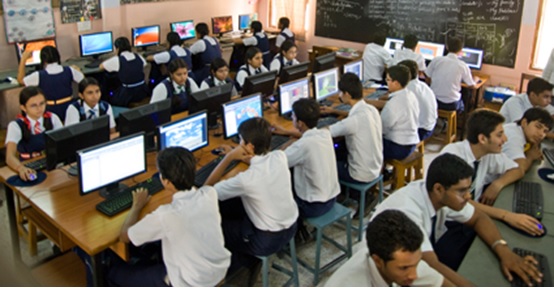
The right use of technology in education can empower both teachers and students, and also make education more affordable and accessible
With the government spending heavily on learning in rural areas and most parents (with higher disposable incomes) ready to spend more on quality education, the education sector continues to have a double-digit growth year after year. However, only a fraction of the education sector in India is technology-enabled, which means there’s a huge opportunity waiting to be tapped for technology companies.
Technology Enabled Learning (TEL): Introduction
The term Technology-enabled learning (TEL) is used to describe the application of technology to teaching and learning. TEL includes use of computers, internet, social media, mobile and tablet devices, and other open educational resources. Experts believe it has the power to transform both teaching and learning in classroom-based and online education.
While the primary focus of TEL is on increasing learner engagement and improving access, experts see TEL playing an important role in communication, information search, collaboration, creation, assessment, and personal or professional development. TEL can expand learning opportunities, enrich experiences, and support greater equality of access around the world.
Students Benefit From Latest Technologies
The Indian education sector is expanding. Both, central and the state governments have big plans to take education beyond cities and towns to the villages. As a result, technology companies, providers of computing hardware, education-related software and content providers, are keen to seize the opportunity.
Here’s how technology is smartly being used in education.
Audio-Visual Learning
Kids learn faster with lights and sounds, instead of just text. Using audio-Video methods to learn helps students understand a concept better and strengthens their pictorial memory.
Smart Classes
Smart classes using popular collaboration tools (such as Google Classroom) is one of the newest developments that you see in the primary schools, especially in urban areas.
Virtual reality (VR)
Virtual Reality (VR) involves the use of computer technology to create a simulated environment, and can be used to provide real-life experience to students. The technology can help in enhancing the classroom experience of a child.
Surveillance ad Monitoring
Parents and teachers alike can make use of surveillance and monitoring to keep an eye on children to ensure their safety.
Global Connect
Students now have access to a global classroom where they can learn about things that are all around the globe. It helps develop a global mindset and nurtures unity.
New Tools & Pedagogy for Teachers and Educational Institutions
Technology is bringing together teachers and learners through smart class rooms, virtual classes, MOOC platforms. The teaching-learning process in varied disciplines is thus transgressing national borders and physical boundaries.
MOOC
The Massive Open Online Course (MOOC) is a model for delivering learning content online to any person who wants to take a course, with no limit on attendance. The transformative potential of online teaching and its reach across geographical zones provides unprecedented challenges and opportunities for making high quality international education accessible by all. The MOOC teacher is an expert in his field and has carefully crafted instructional material, and student is mature and self-motivated, driven more by the need for genuine learning than just acquiring a certificate.
Smart Classes
Smart classes uses informative audios and detailed visuals to explain theoretical concepts. Projectors, short films, documentaries, laboratory experiments and other forms of multimedia content make the teaching of any subject more effective and fun for the learners.
Students are able to visualise a concept in all its details which is not possible through blackboard diagrams. Smart boards allow students and teachers to interact through their laptops which are a new form of classroom participation.
Flipped Classroom
The flipped classroom reverses traditional teaching by placing the responsibility for learning on the student. Here, the learner explores a new concept on his own via reading or lecture videos. The teacher then uses the class time to discuss the knowledge gathered by each one, so that students learn to critically review what they read and then to assess applications in varied situations.
This form of pedagogy is known to develop analytical and reasoning skills, which are useful in all kinds of problem solving. Many international boards like the IB programme differentiate themselves by using the flipped classroom as a core of active learning and concept exploration. Self-driven learning is the valued outcome of this approach as students ingrain the habit of depending on their own research rather than relying on instruction mode for learning new skills,
Distance Learning Programmes
Students who choose to pursue international programs through distance learning are active learners, engaged in what they study. Reputed universities and professional organizations providing distance-learning courses leading to certifications and credit bearing transcripts is the oldest and most enduring form of cross-border education.
Top Online Learning Platforms
Learning does not stop at schools and universities. It’s a lifelong process where individuals must constantly learn and relearn new skills. These online platforms will help you acquire skills, some of which are even recognized by employers.
Leading digital learning platforms such as Udemy, Coursera and Wiley are increasing their focus on India, and are introducing several new courses for the Indian market.
They help learners (of all ages) gain the skills they require to compete in today’s global economy.
Leave a Reply