• Skip to primary navigation
  • Skip to main content
  • Skip to primary sidebar
  • Skip to footer
  • Call: (+91) 9892486442
  • email: info@academicshq.com

AcademicsHQ - Educational resource hub

Comprehensive guides for students and lifelong learners

Business Analysis

  • We help business analysts, students, and managers craft better analysis.
  • Contact us for more information
  • Home
  • Research Process
  • Academic Writing
  • Referencing Guide
  • Resume Writing
Home » Blog » Decision-Making Matrix (Pugh Matrix)

Decision-Making Matrix (Pugh Matrix)

January 13, 2023 by academicshq Leave a Comment

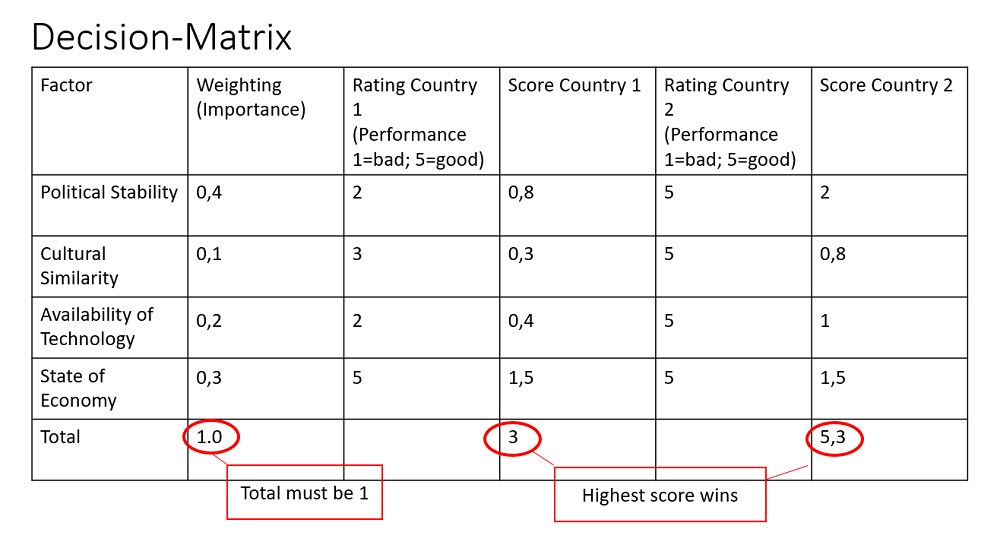
decision matrix for market selection

The Pugh Matrix is a decision-making tool that is used to compare multiple alternatives and select the most favourable one. In this method, the various options are evaluated based on several weighted criteria. This is a variation of the L-shaped matrix.

This tool is also referred to by many other terms such as decision grid, selection matrix or grid, problem matrix, problem selection matrix, opportunity analysis, solution matrix, criteria rating form, criteria-based matrix.

Contents hide
1 When to use a Decision Matrix
2 How to use the Pugh Matrix: Decision-Making Matrix
3 Related posts:

When to use a Decision Matrix

The Decision Matrix is used when one has to select the best option from a list of options, based on several criteria.

Typical situations in which the decision matrix can be used include:

  • Compare several countries/markets based on various criteria and choose the best market (for expanding, launching a product).

  • Choose one solution to implement from various problem-solving approaches.

  • In general, for selecting the best choice from multiple options based on several or criteria.

This tool is commonly used by marketing managers, project managers, business analysts for decision making to choose from several opportunities with complex requirements.

How to use the Pugh Matrix: Decision-Making Matrix

Here’s how to use the Decision-Making Matrix.

Identify the criteria that you consider are the most relevant to assess the attractiveness of the various options.

Once the relevant criteria are, these should be 1) weighted (how important is each factor) and 2) rated using an appropriate numeric scale.

You should use a rating scale for each criterion. Here are some options:

  • 1, 2, 3 (1 = low, 2 = medium, 3 = high)
  • 1, 2, 3, 4, 5 (1 = very poor to 5 = excellent)

Once the scale is decided, each of the factors can be scored on a scale from 1-5, very poor to excellent (assuming you have chosen the 1-5 scale).

The weighted factors help to compare the various options.

Finally, compare the scores of all the options; the option with the highest score should be selected.

It is important to logically build up the decision matrix. The factors should be formulated in a way that the high end of the scale (5 for the above example) is always the rating that would you make to select that option.

Related posts:

  1. Corruption Theories
  2. Tuckman’s theory: Various Stages of Group Development
  3. Belbin’s Team Role Theory
  4. Organizational Structure: Types and Importance
  5. Kohlberg and Gilligan theory of moral development: Differences

Filed Under: General Management

Reader Interactions

Leave a Reply Cancel reply

Your email address will not be published. Required fields are marked *


Primary Sidebar

Microsoft Excel Tutorials
Want to master Excel? Check out our free tutorials on YouTube

Academic Writing: Best Practices

  • How to Choose a Research Topic
  • Academic Writing Guide: Tips & Checklist
  • How to evaluate information sources (CARS Checklist)
  • How to write Literature Review
  • Referencing (Citing) Guide: Harvard, APA and Other Styles
  • How to write conclusion for academic work

Recent Posts

  • Budgeting 101: How Firms Control Their Finances
  • A Tomato that pushes you hard
  • Types of Market Structures Explained
  • The Stability (and Instability) of the Market Economy
  • Measures of Economic Activity and Wellbeing

Footer

ACADEMIC

  • Academic Writing Guide
  • Statement of Purpose
  • Letter of Motivation
  • Personal Statement
  • Letter of Recommendation

JOB

  • Cover Letter
  • Letter of Intent
  • Resume
  • LinkedIn Profile Writing

BUSINESS

  • Pitch Deck
  • Article Writing
  • Blog Writing
  • Case Study
  • Press Release
  • Business Plan
  • Ghostwriting

ABOUT US

  • About Us
  • Contact
  • Privacy Policy
  • Blog

Copyright © 2026 · News Pro on Genesis Framework · WordPress · Log in